
What Happens to a Mortgage, or a Reverse Mortgage, When Someone Dies in California?
The short answer. A mortgage does not go away when the owner dies, but in most families the lender cannot demand full payment just because the house passed to a spouse, a child or another relative. Heirs can usually keep the loan and keep paying it, and federal rules require the servicer to talk to them. A reverse mortgage is different: it comes due at the death of the last borrower, and the family has a limited time, usually six months to a year, to pay it off, sell the house or hand it back. If payments stop on an ordinary mortgage, California’s foreclosure clock starts, and AB 2424 can buy time to sell.
| At a glance | Regular mortgage | Reverse mortgage (HECM) |
|---|---|---|
| Comes due at death? | No. A transfer to a relative at death does not trigger the due-on-sale clause12 U.S.C. § 1701j-3(d) | Yes, when the last borrower dies24 C.F.R. § 206.125 |
| Can heirs keep the house? | Yes, by keeping the payments current | Yes, by paying off the loan or 95% of the appraised value, whichever is less |
| Servicer must talk to heirs? | Yes, once on notice of the death12 C.F.R. § 1024.38(b)(1)(vi) | Yes; HUD requires a due and payable notice to the estate or heirs |
| If payments stop | Notice of default, then notice of sale, then a trustee’s saleCiv. Code, §§ 2924, 2924f | Foreclosure after about six months, unless HUD extensions are granted |
| Time to sell | AB 2424 can postpone the sale twice, at least 45 days each timeCiv. Code, § 2924f | 90-day extensions with proof the house is being sold or refinanced |
| Heirs personally liable? | No, unless they assume the loan | No. They never owe more than the house is worth |
A regular mortgage survives the owner, but the lender usually cannot call it due.
A mortgage is a debt secured by the house. When the owner dies, the debt does not disappear and the lien stays on the property. What changes is who owns the house: a surviving joint tenant, the trustee of a living trust, the heirs, or the estate.
Most mortgages have a “due on sale” clause that lets the lender demand full payment if the house changes hands. A federal law, the Garn-St Germain Act, takes that option away for the transfers that happen at a death. On a home with fewer than five units, the lender may not call the loan due because of a transfer to a relative after the borrower’s death, a transfer to the borrower’s spouse or children, a transfer when a joint tenant dies, or a transfer into a living trust that the borrower benefits from (12 U.S.C. § 1701j-3(d)).
So the family usually has a choice. They can keep making the payments and keep the loan at its current rate, refinance, or sell the house and pay the loan off from the sale. Heirs who keep paying do not become personally liable for the debt unless they formally assume the loan. The house secures it, not them.
The danger is the gap. Payments often stop when the owner dies, because the autopay came from an account that is now frozen or because no one knows who should pay. A few missed payments start the foreclosure process described below, and the servicer does not have to wait for probate to begin it.
In our experience, four servicer problems cause most of the trouble.
The rules give heirs real rights. Servicers do not always follow them. These are the problems we see most often, and the rule that answers each one.
1. The servicer refuses to talk to the heirs.
The most common first call ends with “we can only speak to the borrower.” That is not the rule. Once a servicer learns that a borrower has died, it must have policies to promptly communicate with anyone who may be a “successor in interest,” meaning a person who received the house from the borrower in one of the transfers the Garn-St Germain Act protects, such as a relative who inherited it (12 C.F.R. § 1024.38(b)(1)(vi)). Once the servicer confirms that status, the successor is treated as a borrower for the federal servicing rules, whether or not they have assumed the loan, and the servicer cannot require an assumption first (12 C.F.R. § 1024.30(d)). That means statements, loss mitigation, and the protections against foreclosure while an application is pending.
What to do: put the request in writing, as described below. A phone call is easy to ignore; a written request starts a deadline.
2. The servicer is not clear about what documents it needs.
Families are often told to “send the paperwork” without being told what that is, then told later that something is missing. The servicer must promptly decide which documents it reasonably requires and tell the potential successor (12 C.F.R. § 1024.38(b)(1)(vi)(B)). If you send a written request that names the deceased borrower and identifies the loan, the servicer must answer in writing with a description of the documents it needs and a phone number, generally within 30 days not counting weekends and holidays (12 C.F.R. § 1024.36(i)). If it later cannot decide from what you sent, it must tell you what else it needs.
3. The servicer demands probate letters when none are needed.
Many servicers ask for letters testamentary or letters of administration, the court papers appointing an executor, even when no probate exists or is needed. The federal rule says the documents must be reasonable in light of the state’s law. The Consumer Financial Protection Bureau’s official commentary says that where state law does not require probate to transfer the house, it generally would not be reasonable to require probate documents, and gives joint tenancy and an affidavit of heirship as examples (Official Interpretation, 12 C.F.R. § 1024.38(b)(1)(vi)).
In California, many homes pass without probate. What the servicer can reasonably ask for depends on how the house passed:
| How the house passed | Documents that usually prove it |
|---|---|
| Joint tenancy with a survivor | Certified death certificate and the recorded affidavit of death of joint tenant |
| Living trust that holds the house | Death certificate, the deed into the trust, and the trust or a certification of trust naming the successor trustee |
| Transfer on death deed | Death certificate and the recorded affidavit of death |
| Primary Residence Petition | The court’s order determining succession, recorded |
| Heggstad petition | The court’s order confirming the house to the trust, plus the trust documents |
| Spousal property petition | The court’s spousal property order |
| None of these: the house needs probate | Letters testamentary or of administration. Here the request is reasonable |
When the house really does need a court order, such as a Primary Residence Petition, a Heggstad petition or a probate, the servicer’s demand is a signal to get that order moving, on an emergency basis if a sale is near.
4. The servicer does not assign a single point of contact.
Heirs who call repeatedly often reach a different person every time, each with a different answer. Federal rules require servicers to assign personnel to a delinquent borrower by the 45th day of delinquency, and those people must be able to explain the options and deadlines, track the application, and reach the payment history (12 C.F.R. § 1024.40). A confirmed successor counts as a borrower for that rule. California’s Homeowner Bill of Rights separately requires larger servicers to assign a single point of contact, a person or team, when a borrower asks for an alternative to foreclosure, and that contact must stay assigned until the options are exhausted or the loan is current (Civ. Code, § 2923.7). Ask for the name in writing, and ask for a supervisor if the contact cannot help.
Very small servicers are exempt from some of these federal rules (12 C.F.R. § 1024.30(b)), and California’s single-point-of-contact rule does not apply to servicers that handle few foreclosures. Most families deal with large servicers, where the rules apply in full.
What to put in your written request
Send it by a method you can prove, to the address the servicer designates for written requests (it is usually on the monthly statement or the servicer’s website), and keep a copy. Include: the deceased borrower’s name and the loan number; the property address; a statement that the borrower has died and that you may be a successor in interest under 12 C.F.R. § 1024.38(b)(1)(vi); a request under 12 C.F.R. § 1024.36(i) for a written list of the documents the servicer requires to confirm your status; your contact information; and a copy of the death certificate. Once confirmed, ask for the payoff amount, the payment history, the escrow status and the name of your single point of contact.
If payments stop, the foreclosure clock runs on a set schedule.
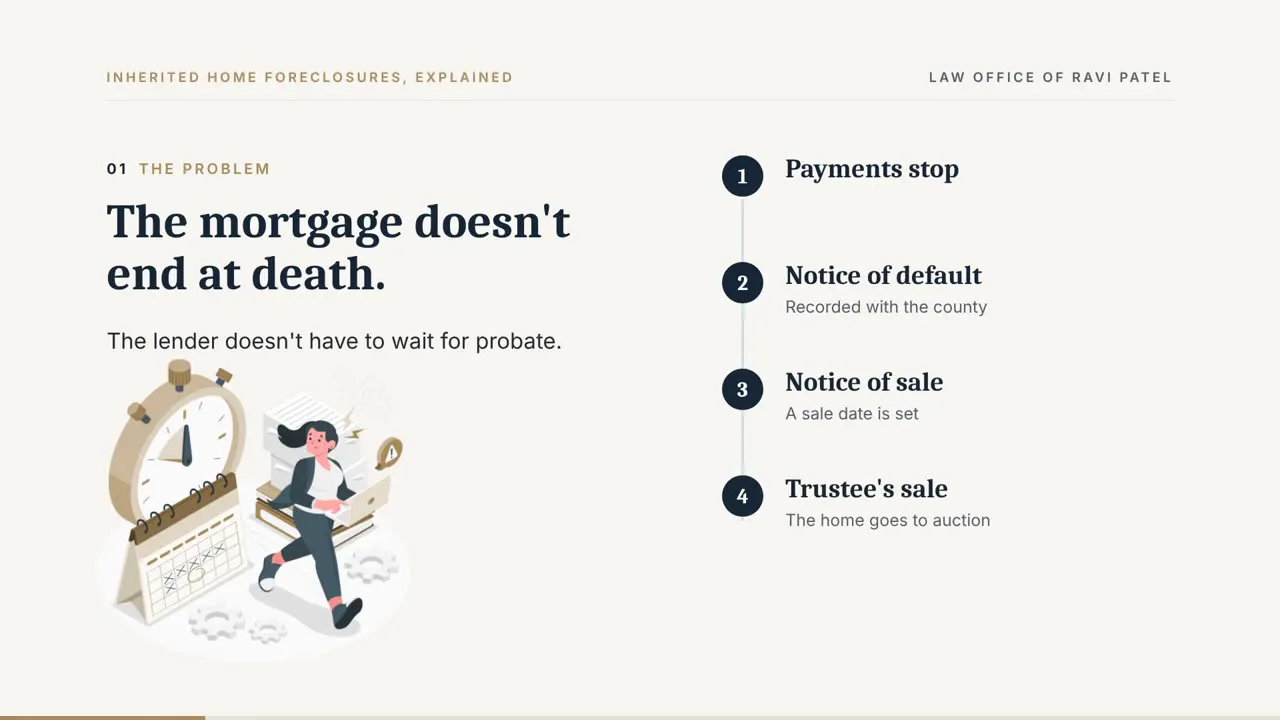
Most California homes are foreclosed without a lawsuit, by a trustee’s sale under the deed of trust. Federal rules generally bar the servicer from starting that process until the loan is more than 120 days past due (12 C.F.R. § 1024.41(f)). Then the steps are set by California law:
- Day 1Payments stopOften the month after the death
- After 120 daysNotice of defaultRecorded with the county
- At least 3 months laterNotice of saleSale set at least 20 days out
- AB 2424Postpone the saleListing, then purchase agreement: at least 45 days each
- Sale dayTrustee’s saleAt least 67% of fair market value at the first sale
AB 2424, effective January 1, 2025, gives families time to sell instead of losing the house at auction. If the foreclosure trustee receives a listing agreement with a licensed real estate broker at least five business days before the sale, the sale is postponed by at least 45 days. Once the house is in escrow, delivering the signed purchase agreement postpones it again, to at least 45 days after delivery. Each postponement can be used once, and the house cannot be sold at the first scheduled sale for less than 67% of its fair market value (Civ. Code, § 2924f). Ravi Patel wrote an article on AB 2424 published by the California Lawyers Association that walks through the documents trustees ask for.
The catch for heirs is authority. Someone has to sign the listing agreement and prove to the trustee that they have the right to. That is the same problem as the servicer’s document demands, and it has the same solutions: a successor trustee’s trust documents, or a court order. When a sale is days away, the court can act quickly. See our article on stopping a foreclosure in a Heggstad case and on emergency probate and trust petitions.
Prefer to watch? This short video covers AB 2424 and how the court can give someone authority to act.
Read the transcript
What can you do when an inherited home is headed for foreclosure? I’m Ravi Patel, a California probate attorney. Here’s a short guide for families.
A mortgage doesn’t end when the borrower dies, and the lender doesn’t have to wait for probate. If payments stop, a notice of default is recorded, and the home moves toward a trustee’s sale.
California’s AB 2424 gives families time. A broker’s listing agreement, delivered to the foreclosure trustee at least five business days before the sale, postpones it by at least 45 days. A signed purchase agreement, at a price that covers the loans, can postpone it again.
But someone needs legal authority to sign that listing. The probate court can provide it, by appointing a trustee or administrator, on an emergency basis when needed, or through a Heggstad or Primary Residence Petition.
When the sale is days away and the lender hasn’t followed the law, a court can be asked for a restraining order to stop it.
That time lets the family sell on the open market, instead of at an auction, where much of the equity can be lost.
I wrote an article on AB 2424 published by the California Lawyers Association, and I put these tools to work for families across California.
Facing foreclosure on an inherited home? Call my office at (510) 443-0443 for a no-cost consultation, before the sale date. I’ll go over your options, and any fee, before you commit to anything.
Illustrations by Storyset.
A reverse mortgage comes due when the last borrower dies.
Most reverse mortgages are federally insured Home Equity Conversion Mortgages, or HECMs. Unlike a regular mortgage, a HECM becomes due and payable when the last surviving borrower dies (24 C.F.R. § 206.125). The servicer must send the estate or heirs a due and payable notice explaining their choices. Under HUD’s rules those choices are to pay off the loan, sell the house for at least 95% of its appraised value, or give the lender a deed in lieu of foreclosure (HUD Mortgagee Letter 2022-15).
- The deathLoan comes dueTell the servicer right away
- About 30 daysDue and payable noticeAnswer it, in writing, with your plan
- Within about 6 monthsPay, sell or deed backBefore the servicer must start foreclosure
- If more time is needed90-day extensionsWith a listing, a sale contract or a loan approval
- OtherwiseForeclosureThe heirs owe nothing beyond the house
- Keeping the house. The family can pay off the loan, often by refinancing. If the loan balance is more than the house is worth, an heir can keep it by paying 95% of the current appraised value, and FHA insurance covers the rest.
- Selling. If the house is worth more than the loan, the heirs keep the difference after the sale. If it is worth less, a sale for at least 95% of the appraised value satisfies the loan (HUD, Inheriting a Home Secured by an FHA-Insured HECM).
- No personal liability. A HECM is a non-recourse loan. The heirs never have to pay more than the house is worth.
- Time. HUD expects the loan to be resolved quickly, and the servicer generally must start foreclosure within six months of the due date. Servicers can approve 90-day extensions, usually up to two, when the family shows it is actively selling or refinancing: a listing agreement, a purchase contract, or a loan application.
- A surviving spouse who was not on the loan may be able to stay in the house as an eligible non-borrowing spouse. HUD requires a certification within 30 days of the borrower’s death, so call the servicer immediately.
- Taxes and insurance. Property taxes and homeowner’s insurance remain the estate’s responsibility until the house is sold or transferred. Unpaid taxes or a lapsed policy can cause their own default.
The same authority problem applies. To list the house, sign a purchase contract or ask for an extension, someone has to show they own the house or can act for its owner. If the house was not in a trust, that usually means a Primary Residence Petition, a Heggstad petition or a probate, and the six-month clock makes it worth starting at once.
What to do in the first 30 days after the death
- Find the most recent mortgage statement, and note the servicer, the loan number and whether it is a regular or reverse mortgage.
- Notify the servicer of the death in writing, with a death certificate, and make the written successor in interest request described above.
- If it is a regular mortgage and the family wants the house, keep the payments current from whatever source is available. Paying does not make you personally liable.
- Confirm the homeowner’s insurance stays in force and the property taxes are paid.
- Work out how the house passes: joint tenancy, trust, transfer on death deed, or the person’s own name. That tells you which documents the servicer should accept and whether you need a court order.
- If a notice of default, a notice of sale or a reverse mortgage due and payable notice arrives, write down every date on it and get legal help that week.
Frequently asked questions
What happens to a mortgage when someone dies in California?
The loan stays in place and the house still secures it. The lender generally cannot call the loan due because the house passed to a relative, a spouse or a living trust at the death, so the heirs can keep paying and keep the loan, refinance, or sell and pay it off. If the payments stop, the servicer can begin foreclosure after the loan is more than 120 days past due.
Can the lender make the heirs pay off the mortgage when the owner dies?
Usually not. The federal Garn-St Germain Act bars lenders from enforcing a due-on-sale clause on a home with fewer than five units when it passes to a relative after the borrower’s death, to a spouse or children, to a surviving joint tenant, or into the borrower’s living trust. The exception is a reverse mortgage, which comes due at the last borrower’s death.
Does the mortgage servicer have to talk to the heirs?
Yes. Federal rules require servicers to communicate promptly with anyone who may be a successor in interest, to tell them in writing what documents are needed to confirm their status, and, once confirmed, to treat them as a borrower for the servicing rules, including loss mitigation.
Can the servicer require probate before it will talk to me?
Not if California law does not require probate to transfer the house. The federal commentary says it generally would not be reasonable to require probate documents where the house passed without probate, as with joint tenancy. If the house passed by a trust, a transfer on death deed or a court order such as a Primary Residence Petition, those documents should be enough.
What happens to a reverse mortgage when the owner dies?
A HECM reverse mortgage becomes due when the last borrower dies. The heirs can pay it off, keep the house by paying 95% of its appraised value if the loan is larger, sell it, or give it back with a deed in lieu of foreclosure. They usually have about six months, with possible 90-day extensions, and they never owe more than the house is worth.
Is a sale date coming?
We help heirs, trustees and administrators deal with servicers, get the court orders that give someone authority to act, and use AB 2424 to postpone a trustee’s sale, in every California county. See Inherited Home Foreclosures. The first consultation is free: book a free consultation or call (510) 443-0443, before the sale date.
Sources
- Garn-St Germain Depository Institutions Act, 12 U.S.C. § 1701j-3(d).
- Regulation X, 12 C.F.R. §§ 1024.30, 1024.36(i), 1024.38(b)(1)(vi) and its official interpretation, 1024.40 and 1024.41(f).
- California Civil Code sections 2923.7, 2924 and 2924f (AB 2424, Stats. 2024).
- 24 C.F.R. § 206.125; HUD, Mortgagee Letter 2022-15; HUD, Inheriting a Home Secured by an FHA-Insured Home Equity Conversion Mortgage.
- Ravi Patel, an article on AB 2424 published by the California Lawyers Association.
More on inherited homes: Inherited Home Foreclosures, Primary Residence Petitions, and what probate costs.
By Ravi Patel, California probate attorney (CA Bar No. 301258). Last updated November 18, 2026. This post is general information, not legal advice, and reading it does not create an attorney-client relationship. Every family’s situation depends on its own facts and loan documents.