
How Much Does Probate Cost in California?
Statutory attorney and executor fees, court costs, and a worked example.
ServicesCalifornia Probate
When probate can’t be avoided, we make it efficient, anywhere in California.
When someone passes away and their estate has to go through the courts, the process can feel slow, formal, and confusing. Our office handles probate from the first filing to the final distribution, so you don’t have to figure it out alone. And when there’s a deadline that can’t wait, such as a foreclosure or a pending sale, we can move quickly, including ex parte.
How probate works, from the first petition to final distribution, and when a shortcut may avoid it.
What does probate involve in California? I’m Ravi Patel, a California probate attorney. Here’s a short guide for families.
Probate is the court process for settling an estate. It’s usually needed when someone dies owning property in their own name, without a living trust. And a will by itself does not avoid probate.
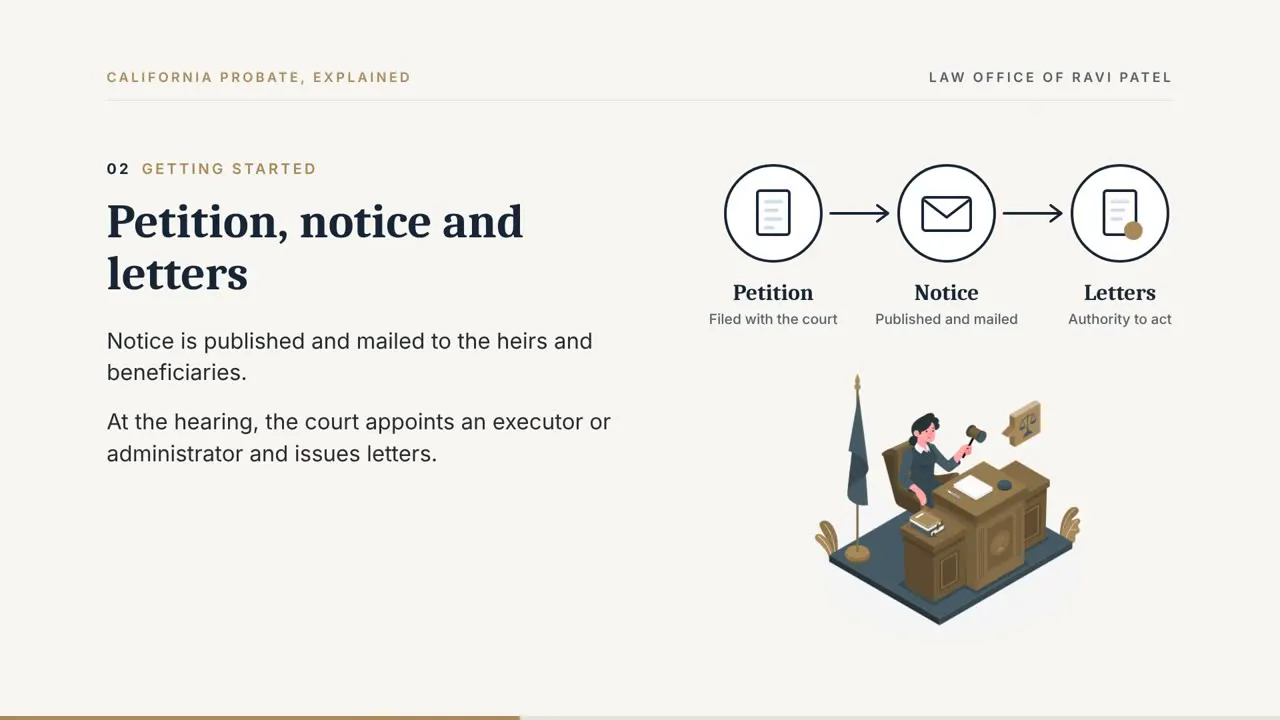
It starts with a petition. Notice is published and mailed to the heirs and beneficiaries. At the hearing, the court appoints an executor or administrator and issues letters, the legal authority to act for the estate.
Then the estate is administered. Creditors get notice and time to make claims, a probate referee appraises most of the assets, and property can be sold if needed.
At the end, the court approves a petition for final distribution, and what’s left passes to the people entitled to it.
A typical probate takes a year or more. When a foreclosure or a pending sale can’t wait, the court can be asked to act on an emergency basis, ex parte.
But not every estate needs a full probate. If a shortcut fits, like a Heggstad petition or a Primary Residence Petition, I’ll tell you.
Facing a probate? Call my office at (510) 443-0443 for a no-cost consultation. Fees for ordinary services are set by California statute, with discounts for smaller estates where appropriate.
Illustrations by Storyset.
Probate is the court-supervised process of settling a person’s estate after they die: paying their debts and passing what’s left to the people entitled to it. A judge appoints someone to manage the estate, oversees that work, and signs off before anything is distributed.
You generally need probate when the person who died owned assets in their own name with no other way to transfer them. That usually happens when there was no living trust, when assets were left out of a trust and can’t be brought back in another way, when there is a will but no trust (a will by itself does not avoid probate), or when there is no will at all and the estate passes under California’s intestacy rules.
Not every estate has to go through full probate. If your situation can be handled by a Heggstad petition or one of California’s probate shortcuts, we’ll tell you; those are normally faster and less expensive.
We handle the whole probate, from start to finish:
You don't need to know which of these your estate requires. We'll map it out at the first consultation and handle the paperwork and court appearances from there.
Probate normally moves on the court's schedule, with hearings set weeks or months out. Most of the time that's fine. But some problems can't wait that long, and waiting can mean losing the very asset the family is trying to protect. If the family home is heading toward a foreclosure sale, if a property is in escrow and the deal will collapse without authority to sign, or if estate assets are at risk while everyone waits for a hearing date, there are faster options.
When the situation is urgent, we can ask the court to act ex parte: on shortened notice, sometimes within days instead of months. That can mean having a special administrator appointed to step in and protect the estate right away, getting authority to sell or refinance a property before a deadline passes, or taking emergency steps to keep assets from being lost.
We've done this for clients facing foreclosure, pending sales, and other deadlines that don't move. If you're up against the clock, call us before the date passes. The sooner we know, the more we can do.
Our office is based in Oakland, but we file probate matters throughout the state, in all 58 California counties. Where your loved one lived, or where the property sits, doesn't limit us. We handle the filing, the notices, and the hearings wherever the estate belongs.
We've completed probate matters across California, including in Los Angeles, Alameda, and Contra Costa Counties. We've also handled ex parte matters for clients facing foreclosure, pending sales, and other urgent deadlines, where getting in front of a judge quickly made the difference.
If your matter involves a dispute (a contested will, a disagreement over who should serve, or a challenge to how the estate is being handled), we have the experience to take it on. But most estates don't need a fight, and our focus is on getting yours administered and closed as smoothly as possible.
California sets attorney's fees for probate by statute. The fee is a percentage of the estate's value, fixed by law, so you have a clear idea of the cost up front. For smaller estates, we apply a discount to the statutory fee where appropriate. We'll walk you through what the fee looks like for your estate at your first consultation, before you commit to anything. Call (510) 443-0443 for a no-cost consultation.
For a full breakdown, with court costs, an example and a timeline, see our guide How much does probate cost in California?
Book online, or by calling or texting (510) 443-0443.
Speak with an attorney about the estate and what probate will involve, and get a clear picture of the fees.
Our office prepares and files the Petition for Probate, publishes and serves the required notices, and gets you appointed as executor or administrator.
Once the court issues Letters, we help you administer the estate: creditor notice, the Inventory and Appraisal, and any sale of property.
We prepare the final accounting and the petition for distribution, so the remaining assets pass to the people entitled to them.
Statutory attorney and executor fees, court costs, and a worked example.
When an estate is small enough to skip probate, and a free form you can download.
The court-free route for land or a share of a house of low value.
What changed in 2025 for the family home, and the catches worth knowing.
Where the examiner's notes appear, what they mean, and how to answer them before the hearing.
The four courthouses that now hear probate in Los Angeles County, and what to expect on timing.
Keeping the loan, dealing with the servicer, and reverse mortgages that come due.
How the court can act in days when a sale, foreclosure or deadline cannot wait.
Book a free consultation. We will map out what your estate needs and what it will cost.