
How Much Does Probate Cost in California, and How Long Does It Take?
The short answer. In California, the attorney’s and the executor’s fees for ordinary probate work are set by statute as a percentage of the estate’s gross value: 4% of the first $100,000, 3% of the next $100,000 and 2% of the next $800,000, with lower rates above $1 million. Each of them may receive that amount, so a $750,000 estate carries up to $36,000 in combined statutory fees, plus a few thousand dollars in court and other costs. A simple probate usually takes 9 to 18 months. Many families can avoid probate, or most of it, with a shortcut.
| At a glance | California probate, 2026 |
|---|---|
| Attorney’s fee | Set by statute: 4% / 3% / 2% / 1% / 0.5% in tiers of the gross estateProb. Code, § 10810 |
| Executor’s commission | The same amount again, unless the executor waives itProb. Code, § 10800 |
| Measured on | Gross value of the probate estate; mortgages and other debts are not subtractedProb. Code, § 10800, subd. (b) |
| Extra work | “Extraordinary” fees, such as for selling a house or litigation, only with court approvalProb. Code, § 10811; Cal. Rules of Court, rule 7.703 |
| Court filing fee | $435 for the petition for probate in most counties ($450 in Riverside and San Francisco)Gov. Code, § 70650; Statewide Civil Fee Schedule (Jan. 1, 2026) |
| Probate referee | 0.1% of the assets the referee appraises, $75 minimum, $10,000 maximumProb. Code, § 8961 |
| When fees are paid | From the estate, and only after the court approves them, usually at the endCal. Rules of Court, rule 7.700 |
| How long | Usually 9 to 18 months; the court expects a final petition or a status report within one year of appointmentProb. Code, § 12200 |
Estimate your estate’s fees with our probate calculator
California sets probate fees by statute, as a percentage of the estate.
California is one of the few states where the law, not the lawyer, sets the fee for an ordinary probate. The attorney for the estate and the personal representative (the executor named in the will, or an administrator if there is no will) are each entitled to compensation figured on the same schedule (Prob. Code, § 10800; § 10810):
| Part of the estate | Rate | Fee on that part |
|---|---|---|
| First $100,000 | 4% | Up to $4,000 |
| Next $100,000 | 3% | Up to $3,000 |
| Next $800,000 | 2% | Up to $16,000 |
| Next $9,000,000 | 1% | Up to $90,000 |
| Next $15,000,000 | 0.5% | Up to $75,000 |
| Above $25,000,000 | A reasonable amount set by the court | |
Added up, the schedule produces these combined fees for the attorney and the executor together:
For any other figure, enter the estate’s value in our California probate fee calculator. It shows each tier of the calculation.
The fee is figured on the gross estate, so a mortgage does not lower it.
The base for the fee is the “estate accounted for”: the appraised value of the probate assets, plus any gains on sales and other receipts, minus any losses on sales, without subtracting what the estate owes (Prob. Code, § 10800, subd. (b); Cal. Rules of Court, rule 7.705). A house appraised at $800,000 counts as $800,000 even if $500,000 is still owed on it.
What the fee base leaves out matters just as much. Only probate assets count. These usually do not:
- property already held in a living trust;
- life insurance and retirement accounts with a living named beneficiary;
- payable-on-death and transfer-on-death accounts;
- property held in joint tenancy with someone who survived; and
- property that passes to a surviving spouse or registered domestic partner through a spousal property petition.
So the estate in probate is often much smaller than everything the person owned.
What a typical probate costs: an example.
Suppose a mother dies without a trust, leaving a house worth $800,000 with a $500,000 mortgage, and a $40,000 checking account. Her will names her son as executor and waives bond. The gross probate estate is $840,000, and her equity is only $340,000.
| Cost | Amount | How it is figured |
|---|---|---|
| Attorney’s statutory fee | $19,800 | $4,000 + $3,000 + 2% of $640,000 |
| Executor’s statutory commission | $19,800 | The same schedule; the son may waive it |
| Court filing fees | $870 | $435 for the petition for probate and $435 for the petition for final distribution |
| Probate referee | $800 | 0.1% of the house; the executor values the cash himself |
| Newspaper publication | About $400 | Varies by newspaper and county |
| Total | About $41,700 | About $21,900 if the son waives his commission |
Two things stand out. First, the fees come to about 12% of the family’s equity, because the mortgage does not reduce them. Second, the price of this probate turns on the house. If the house had been worth $750,000 or less, the family could have transferred it with a Primary Residence Petition instead, and collected the checking account with a small estate affidavit. If a living trust had named the house but the deed was never changed, a Heggstad petition could have confirmed it to the trust. None of those carry the statutory percentage fee.
Court costs, the referee and publication add a few thousand dollars.
- Filing fees. The petition for probate costs $435 in most counties; Riverside and San Francisco add a courthouse surcharge, for $450 (Gov. Code, § 70650; Statewide Civil Fee Schedule). Later petitions, such as one to confirm a sale or for final distribution, usually carry a fee too.
- The probate referee. A state-appointed referee appraises the house and most other non-cash assets for a fee of one-tenth of 1% of their value, at least $75 and no more than $10,000 unless the court allows more, plus expenses (Prob. Code, § 8961). Cash and bank accounts are valued by the executor at no charge.
- Publication. The notice of the petition must run three times in a local newspaper before the first hearing (Prob. Code, § 8121). In our experience the cost is a few hundred dollars and varies with the newspaper.
- Bond. Unless the will waives bond or the beneficiaries agree to waive it, the executor buys a surety bond and pays an annual premium from the estate (Prob. Code, §§ 8480, 8481). The court may also require one if the executor lives outside California.
- Small items. Certified copies of the letters, certified death certificates, recording fees for a deed, and sometimes appraisals or tax preparation.
Extraordinary fees are extra, and the court must approve them.
The statutory fee covers ordinary work: opening the estate, giving notice, handling creditor claims, the inventory and the final petition. Copies, postage and routine overhead are included and should not be billed separately. For work beyond that, the attorney or the executor may ask the court for an additional “extraordinary” fee (Prob. Code, § 10811). The Rules of Court list common examples: selling real estate, litigation to protect the estate, defending a will contest, handling tax audits, and unusual efforts to locate assets (Cal. Rules of Court, rule 7.703).
Extraordinary fees are never automatic. The person asking must show what was done, why it was needed and how it helped the estate, usually with hourly records, and the heirs get notice and can object (Cal. Rules of Court, rule 7.702).
The estate pays the fees, and only after the court approves them.
The heirs do not write checks out of their own pockets. Probate fees are an expense of administration paid from the estate before anything is distributed. No attorney or executor may take a fee, ordinary or extraordinary, before the court signs an order allowing it (Cal. Rules of Court, rule 7.700). Most fees are approved at the end, together with the petition for final distribution, although the court can allow part of the ordinary fee earlier, at least four months after the executor is appointed (Prob. Code, § 10830).
A few more points families ask about:
- The executor can waive the commission. An executor who is also the main beneficiary often does, because the commission is taxable income. The decision has tax consequences, so ask a tax adviser, and put the waiver in writing early in the case.
- An agreement for more than the statute allows is void (Prob. Code, §§ 10803, 10813). Some attorneys agree to less on smaller estates.
- Delay can cost the professionals. If a probate runs past its deadlines for reasons within the executor’s or the attorney’s control, the court can reduce their fees (Prob. Code, § 12205).
A simple California probate takes about 9 to 18 months.
- Month 0Petition filedNotice mailed and published before the hearing
- About months 1 to 3Hearing and lettersThe court appoints the executor
- Four months after lettersCreditor deadlineInventory and appraisal due by then too
- Months 5 to 12Clean-upPay claims, sell property if needed, file tax returns
- Months 9 to 18Final distributionCourt approves fees and distribution
- Filing and notice. The petition for probate (Form DE-111) is filed in the county where the person lived. The clerk sets a hearing, by statute 15 to 30 days out (Prob. Code, § 8003), though busy courts often set it later; in Los Angeles a new probate petition is now heard about five weeks after filing (see our Los Angeles timing article). Notice goes by mail to the heirs and beneficiaries at least 15 days before the hearing, and is published three times (Prob. Code, §§ 8110, 8121).
- The hearing. The court’s probate examiners review the petition first and post notes listing anything missing. If the notes are cleared, the court appoints the executor and letters issue. If not, the hearing is usually continued for several weeks.
- The creditor period and inventory. Creditors have four months from the date letters issue to file claims (or 60 days after the executor mails them notice, if later) (Prob. Code, § 9100). The inventory and appraisal is due within the same four months (Prob. Code, § 8800).
- Administration. The executor pays valid claims, manages or sells property, and files the final tax returns. With authority under the Independent Administration of Estates Act, many steps, including a sale, can be done with a 15-day notice to the heirs instead of a court hearing.
- Final distribution. Once the creditor period has run and the estate is in order, the executor files a petition for final distribution, which also asks the court to approve the fees. Within one year after letters issue (18 months if a federal estate tax return is required), the executor must either file that petition or report to the court why the estate cannot close (Prob. Code, § 12200).
What makes a probate take longer: hearings continued for unresolved notes, heirs who cannot be found, a will contest or a dispute among siblings, a creditor fight, selling a house in a slow market, and courts with crowded calendars.
Prefer to watch? This short video walks through the probate process from the first petition to final distribution.
Read the transcript
What does probate involve in California? I’m Ravi Patel, a California probate attorney. Here’s a short guide for families.
Probate is the court process for settling an estate. It’s usually needed when someone dies owning property in their own name, without a living trust. And a will by itself does not avoid probate.
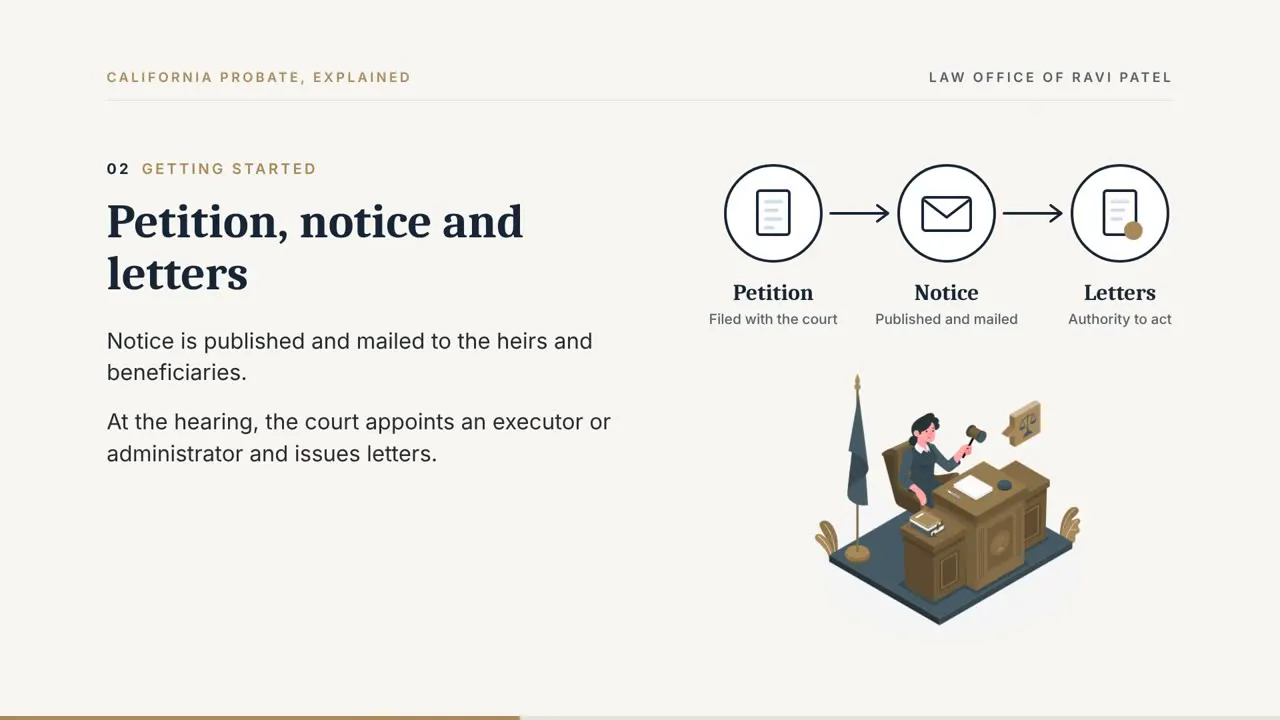
It starts with a petition. Notice is published and mailed to the heirs and beneficiaries. At the hearing, the court appoints an executor or administrator and issues letters, the legal authority to act for the estate.
Then the estate is administered. Creditors get notice and time to make claims, a probate referee appraises most of the assets, and property can be sold if needed.
At the end, the court approves a petition for final distribution, and what’s left passes to the people entitled to it.
A typical probate takes a year or more. When a foreclosure or a pending sale can’t wait, the court can be asked to act on an emergency basis, ex parte.
But not every estate needs a full probate. If a shortcut fits, like a Heggstad petition or a Primary Residence Petition, I’ll tell you.
Facing a probate? Call my office at (510) 443-0443 for a no-cost consultation. Fees for ordinary services are set by California statute, with discounts for smaller estates where appropriate.
Illustrations by Storyset.
You need probate only for what nothing else can transfer.
Probate is required when a person dies owning property in their own name that has no other legal way to pass. A will alone does not avoid it. Before opening a probate, check the shortcuts in this order; the first one that fits is usually the cheapest:
- Small estate affidavit (Prob. Code, § 13100): bank accounts and other personal property when what counts is $208,850 or less. No court filing. See our guide and free form.
- Primary Residence Petition (Prob. Code, § 13151): the family home, if worth $750,000 or less. One petition and one hearing. See Primary Residence Petitions.
- Heggstad petition (Prob. Code, § 850): property a living trust describes but that was never retitled to it. See Heggstad petitions.
- Spousal or domestic partner property petition (Prob. Code, § 13650): property passing to a surviving spouse or partner, with no value limit.
- Affidavit for real property of small value (Form DE-305; Prob. Code, § 13200): all California real estate worth $69,625 or less. See our DE-305 article.
An overview of all of them is on our probate shortcuts page.
Checklist before you decide on probate
- List what the person owned and how each item was titled: own name, trust, joint tenancy, or with a named beneficiary.
- Get date-of-death values for everything in the person’s own name, without subtracting loans.
- Check each shortcut above against what is left; several can be combined.
- If probate is needed, run the gross value through the probate fee calculator and add a few thousand dollars for costs.
- Find the original will, and see whether it waives bond and names an executor.
- If the executor is also a main beneficiary, ask a tax adviser about waiving the commission.
- Ask the attorney, in writing, which work they would treat as extraordinary.
Frequently asked questions
How much does probate cost in California?
The attorney and the executor are each entitled to a statutory fee of 4% of the first $100,000 of the gross estate, 3% of the next $100,000 and 2% of the next $800,000, with lower rates above $1 million. On a $750,000 estate that is $18,000 each, or $36,000 together, plus court costs, the referee’s fee and publication, and any extraordinary fees the court approves.
Are probate fees based on the value before or after the mortgage?
Before. The fee is figured on the gross value of the probate assets, so a house appraised at $800,000 counts as $800,000 even if a loan is owed on it. Assets in a living trust, accounts with named beneficiaries and joint tenancy property are not part of the probate estate and do not count.
Who pays the probate attorney, and when?
The estate pays, not the heirs personally, and only after the court approves the fee. Most fees are approved with the petition for final distribution at the end of the case, although the court can allow part of the ordinary fee after the executor has served for four months.
How long does probate take in California?
A simple, uncontested probate usually takes 9 to 18 months from filing to final distribution. The creditor period alone runs four months after the executor is appointed, and the executor must file for final distribution or report to the court within one year. Disputes, a house sale or a crowded court calendar can add months.
When is probate required in California?
When a person dies owning property in their own name that cannot pass any other way. A will alone does not avoid probate. Property in a living trust, accounts with named beneficiaries and joint tenancy property pass without it, and small estates and homes worth $750,000 or less can often use a shortcut instead.
Not sure you need a full probate?
Tell us what the person owned and we will tell you whether a shortcut fits. We handle probate, Primary Residence Petitions and Heggstad petitions in every California county, and the first consultation is free. Book a free consultation or call (510) 443-0443.
Sources
- California Probate Code sections 8003, 8121, 8800, 8961, 9100, 10800, 10810, 10811, 10830 and 12200; Government Code section 70650.
- California Rules of Court, rules 7.700 to 7.707 (compensation in decedents’ estates).
- Judicial Council of California, Statewide Civil Fee Schedule (effective January 1, 2026), probate items 124 and 150 and the local surcharge appendix; Form DE-300 (Rev. April 28, 2025).
- California Decedent Estate Practice (Cont.Ed.Bar 2026), chapter 30 (computing the estate accounted for, excluded property, waivers, extraordinary services, timing of payment).
More on probate: California probate, the probate fee calculator, and probate shortcuts.
By Ravi Patel, California probate attorney (CA Bar No. 301258). Last updated November 18, 2026. This post is general information, not legal advice, and reading it does not create an attorney-client relationship. Every estate depends on its own facts.