
California Small Estate Affidavit (2026): Limits, the Form, and How to Fill It Out
The short answer. If someone in California died on or after April 1, 2025, and the property they left in their own name is worth $208,850 or less, their heirs or beneficiaries can collect bank accounts, investment accounts and other personal property with a small estate affidavit instead of a probate. Wait at least 40 days after the death, make sure no probate is open, have every person who inherits the property sign in front of a notary, and give the affidavit to the bank with a certified death certificate and Form DE-300. Nothing is filed with the court. The affidavit cannot transfer a house.
| At a glance | California small estate affidavit |
|---|---|
| Also called | Affidavit for Collection of Personal Property; Probate Code section 13100 affidavitProb. Code, §§ 13100 to 13116 |
| Limit | $208,850 for a death on or after April 1, 2025, counting only property that would otherwise need probateForm DE-300 (Rev. April 28, 2025) |
| Waiting period | 40 days after the deathProb. Code, § 13100 |
| Who signs | Everyone who inherits the item, or the trustee if a pour-over will leaves it to a trustProb. Code, §§ 13006, 13051 |
| Attach | Certified death certificate, Form DE-300, evidence of ownership; a probate referee appraisal if there is California real estateProb. Code, §§ 13101, 13102, 13103 |
| Filed with the court? | No. It goes to the bank or other holder. |
| Transfers a house? | No. See the options for real estate below. |
Check four things before you use the affidavit.
The affidavit is a sworn statement. The bank can rely on it without checking anything (Prob. Code, § 13106), so the law puts the burden on you to get it right. Before anyone signs, confirm all four of these:
- At least 40 days have passed since the death. Count from the date on the death certificate. Day 40 is the earliest you can sign.
- No probate is open in California. If someone has filed a petition for probate, or a court has appointed an executor or administrator, you can use the affidavit only if that personal representative consents in writing, and you attach the consent and their letters (Prob. Code, § 13101, subd. (e)).
- The property that counts is worth no more than the limit. For a death on or after April 1, 2025, that is $208,850. The next section explains what counts.
- You are the person entitled to the property. The law calls you the “successor”: the beneficiary under the will, or the heirs under California law if there is no will (Prob. Code, § 13006).
The limit is $208,850 for deaths on or after April 1, 2025.
The dollar limit changes every three years with inflation, and the one that applies is the one in effect on the date of death, not the date you sign (Prob. Code, §§ 890, 13101, subd. (g)). The Judicial Council publishes the current figures on Form DE-300, and you must attach that form to the affidavit for any death on or after April 1, 2022.
| Date of death | Small estate affidavit limit |
|---|---|
| On or after April 1, 2025 | $208,850 (next adjustment due April 1, 2028) |
| April 1, 2022, to March 31, 2025 | $184,500 |
| Before April 1, 2022 | $166,250 (lower for earlier years) |
Be careful with figures you find online. When we checked in November 2026, some pages still gave the 2022 figure as current, and at least one law firm page gave a 2026 figure that does not exist. The DE-300 controls.
Most of what people leave behind does not count toward the limit.
The limit applies to the gross value, on the date of death, of what the person owned in California in their own name, without subtracting any loan. But the law leaves out everything that passes to someone on its own (Prob. Code, § 13050). In practice, that is most of a typical estate.
What this animation shows
Eight assets appear one at a time and move to one of two columns. Does not count: a house held in a living trust ($1,050,000), a 401(k) with the daughter named as beneficiary ($210,000), a car registered with the DMV ($14,000), a savings account payable on death to the son ($25,000), and a final paycheck ($3,200, because wages up to $20,875 are excluded). Counts toward the limit: a checking account in her name ($38,400), a brokerage account in her name ($92,000), and a coin collection ($6,500). A meter adds up what counts: $136,900, under the $208,850 limit, so the heirs can collect those three assets with a small estate affidavit. If the house had been in her own name, its value would count and put the estate far over the limit.
Does not count
Leave these out of the total
- Anything in a living trust
- Joint tenancy property
- Bank accounts with a payable-on-death (POD) or transfer-on-death (TOD) beneficiary, or a surviving joint owner
- Life insurance, retirement accounts and annuities with a living named beneficiary
- Cars, boats and mobilehomes registered with the DMV or HCD (they have their own transfer forms)
- Property passing to a surviving spouse or registered domestic partner
- Unpaid wages up to $20,875, and military pay
Counts
Add these up at their full value
- Bank and brokerage accounts in the person’s name alone, with no beneficiary
- Stocks, bonds and certificates in the person’s name
- Valuables, collections, jewelry and other belongings
- Refunds, final checks and money owed to the person
- Insurance or retirement money payable to the estate
- California real estate in the person’s own name, even though this affidavit cannot transfer it
- Only the person’s half of community property
One more rule helps families with a house. If you file a Primary Residence Petition for the home, the home’s value is left out when you add up the rest of the estate for the affidavit (Prob. Code, § 13100). So a family can sometimes use both: the petition for the house and the affidavit for the accounts.
Check your estate in two minutes.
Answer the questions and add up only the property that counts. This is a rough check, not legal advice. Nothing you enter leaves your browser.
Counts toward the limit$0
Limit for this date of death: $208,850
Every person who inherits the property signs the affidavit.
The person who signs is the “successor,” and if there is more than one, all of them sign (Prob. Code, §§ 13006, 13101, subd. (b)). Who that is depends on the estate plan:
A pour-over will
The will leaves everything to a living trust
This is the easy case. The trust is the beneficiary, so the trustee signs on its behalf (Prob. Code, §§ 13006, subd. (a), 13051) and checks the second box in paragraph 8. Give the bank a copy of the will and a certification of trust.
A regular will
The will names people
Everyone the will gives the item to signs. If the will leaves the account to two people, both sign and both are paid.
No will
California’s intestacy law decides
Every heir signs and takes the share the law gives them (Prob. Code, §§ 6401, 6402). Three children with no surviving spouse means three signatures and a one-third share each. If one heir will not sign, the affidavit will not work for that item.
How to fill out the small estate affidavit, paragraph by paragraph.
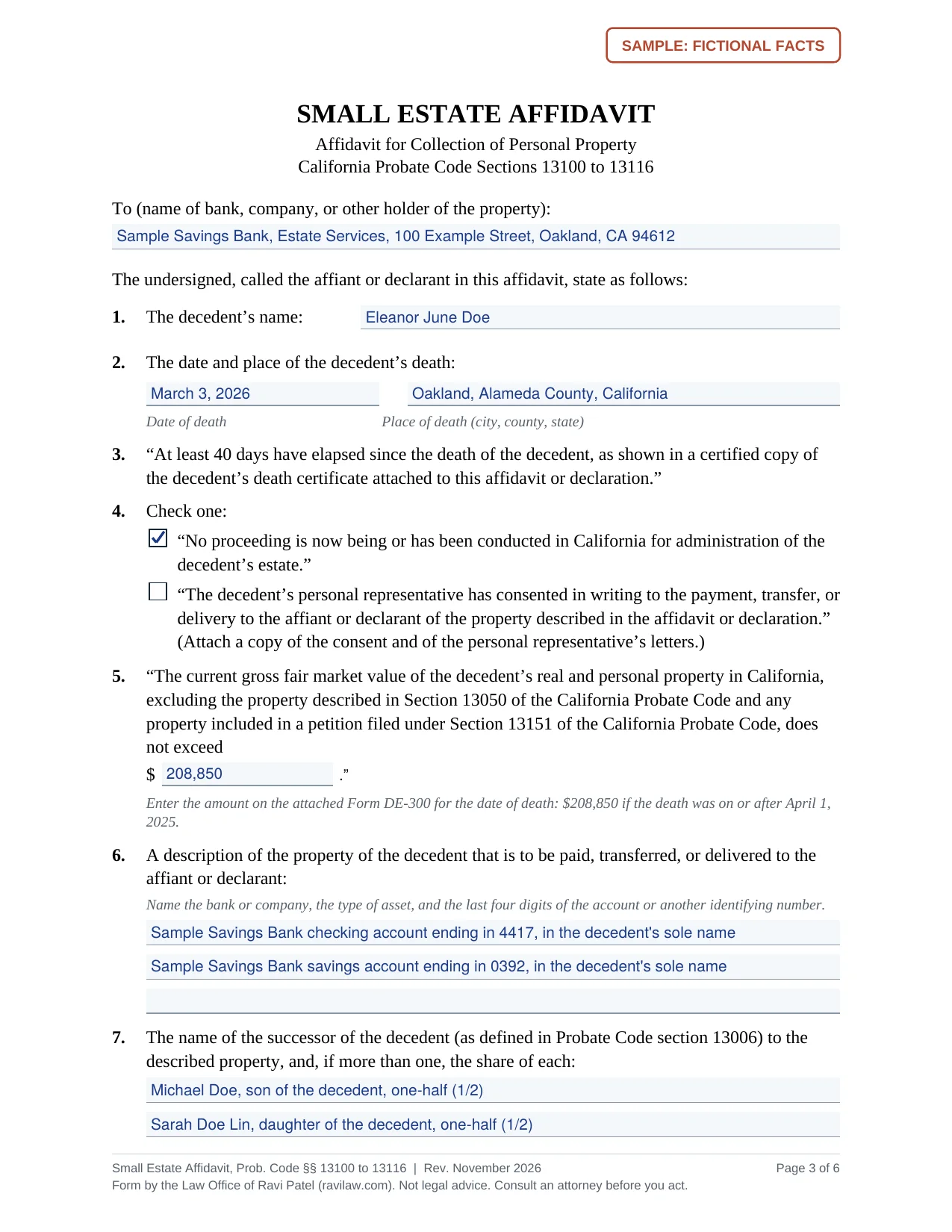
Our form follows the wording the statute requires (Prob. Code, § 13101). Keep that wording. The Sacramento County Public Law Library warns that changing the required language can affect whether the affidavit is valid. Here is a filled-in sample with fictional facts: two adult children collecting their mother’s accounts with no will.
 1
2
3
4
5
6
7
- The holder. Use one affidavit for each bank or company. Call first and ask whether it has its own form; using it often speeds things up.
- The decedent’s name, exactly as it appears on the death certificate.
- Date and place of death. The date must be at least 40 days before you sign.
- Paragraph 4. Check the first box unless a probate is open and the personal representative has consented in writing.
- Paragraph 5. Enter the DE-300 limit for the date of death: $208,850 for deaths on or after April 1, 2025.
- Paragraph 6, the property. Describe each asset so no one could mistake it for another: the bank or company, the type of account, and the last four digits of the account number. For stock, give the company, the number of shares and the certificate or brokerage account. This affidavit is your record of what you took and why you had the right to it if ownership is ever questioned.
- Paragraph 7, the successors. Name everyone who inherits the property and each one’s share.
 8
9
10
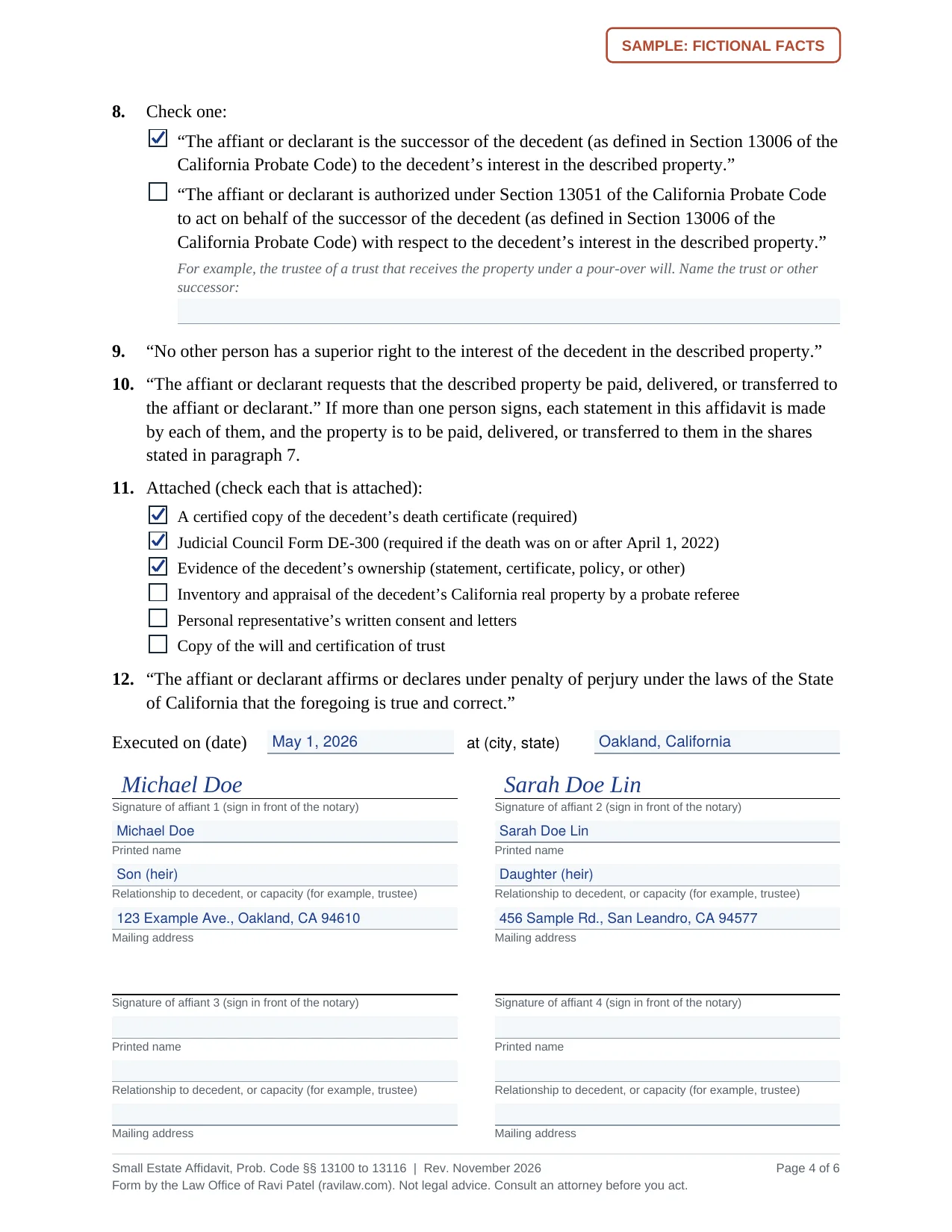
- Paragraph 8. Heirs and beneficiaries check the first box. A trustee signing for a trust under a pour-over will checks the second box and names the trust.
- Paragraph 11, the attachments. Check each document you attach (see the next section).
- Signatures. Every successor signs in front of a notary, who completes the acknowledgment on page 5 of our form. Fill in the date and city where you sign.
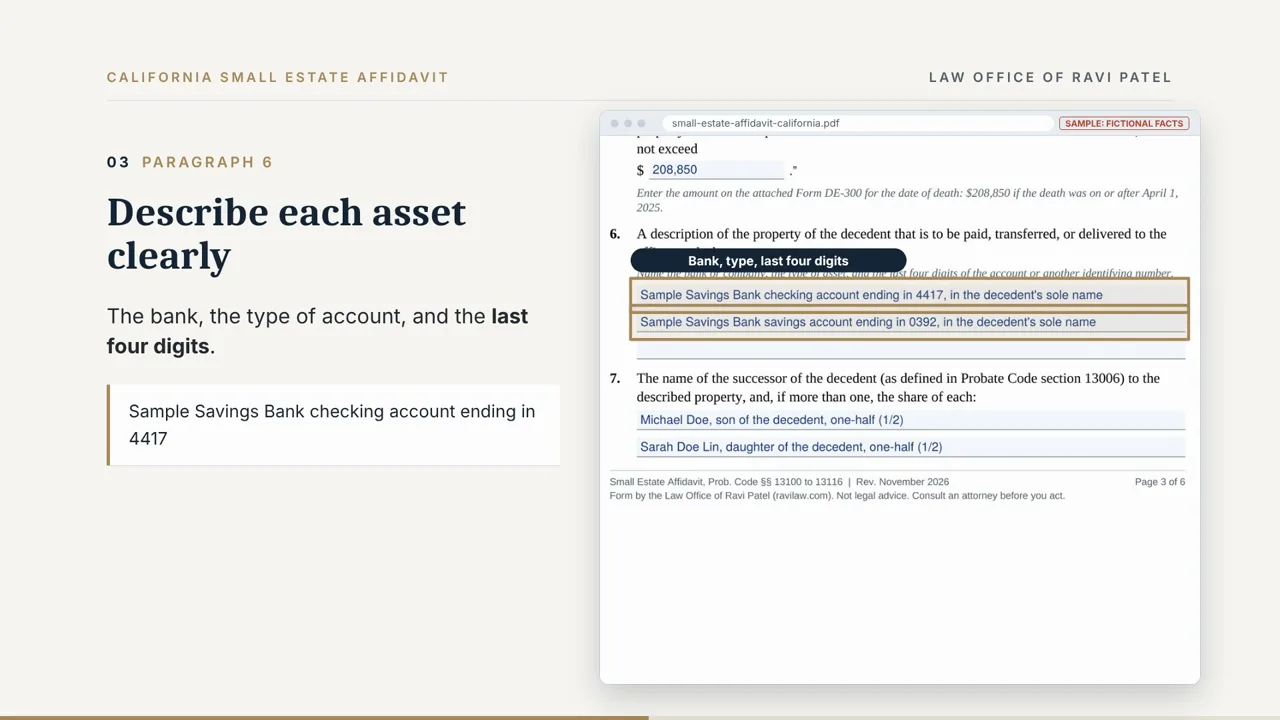
Prefer to watch? This short video walks through the same form, section by section, filled in with the fictional facts above.
Read the transcript
How to fill out a California small estate affidavit. I’m Ravi Patel, a California probate attorney. Let’s walk through our free form, one section at a time.
Before anyone signs, check four things. At least 40 days have passed since the death. No probate case is open in California. The property that counts is worth $208,850 or less, for a death on or after April 1, 2025. And everyone who inherits the property is ready to sign.
At the top, name the bank or company that holds the property. Use a separate affidavit for each one, and ask first whether it has its own form. Then give the decedent’s name exactly as it appears on the death certificate, and the date and place of death.
Paragraphs 3 through 5 are statements the law requires. In paragraph 4, check the first box unless a probate is open and the executor or administrator has consented in writing. In paragraph 5, enter the limit from Form DE-300 for the date of death.
Paragraph 6 is the most important line on the form. Describe each asset so clearly that no one could mistake it: the bank, the type of account, and the last four digits of the account number. If anyone ever questions who owns that money, this affidavit is your record of what you took and why you had the right to take it.
In paragraph 7, list everyone who inherits the property and each person’s share. With a pour-over will, that is simple: the trustee signs for the trust and checks the second box in paragraph 8. With no will and several heirs, every heir is listed, every heir signs, and each takes an equal share, or the share California law gives them.
Paragraph 11 lists the attachments. Always include a certified copy of the death certificate, not an informational copy. Attach Form DE-300, which comes with our download, and a recent statement or other proof of ownership.
Every person who signs does so in front of a notary, who completes the acknowledgment on page 5. One missing signature can stop the bank from paying.
Then take the packet to the bank and keep a copy of everything. One more thing: this affidavit cannot transfer a house. For the family home, look at a Primary Residence Petition.
Download the free form at ravilaw.com. Questions? Call my office at (510) 443-0443 for a no-cost consultation.
The form is shown with fictional facts. Narrated in Ravi Patel’s voice using an AI voice tool.
Attach these documents, or the bank can say no.
- A certified copy of the death certificate. Required (Prob. Code, § 13101, subd. (d)). Get a certified copy that is not stamped “Informational, Not a Valid Document to Establish Identity”; a holder may not accept that kind.
- Form DE-300. Required for any death on or after April 1, 2022 (Prob. Code, § 13101, subd. (f)). Our download includes it as the last page.
- Evidence of ownership, if the person had it: a recent statement, a stock certificate, a policy. Without it, the holder can ask for a bond or an indemnity agreement before it pays (Prob. Code, § 13102).
- A probate referee’s inventory and appraisal of any California real estate the person owned in their own name (Prob. Code, § 13103). The affidavit cannot transfer the real estate, but its value counts, so the bank needs proof of what it is worth.
- The personal representative’s consent and letters, only if a probate is open.
- For a trustee: a copy of the pour-over will and a certification of trust.
Sign in front of a notary, then take it to the bank.
- Step 1GatherDeath certificates, statements, the will or trust
- Step 2Add it upOnly the property that counts, at date-of-death value
- Step 3Wait 40 daysCount from the date of death
- Step 4SignEvery successor, in front of a notary
- Step 5PresentTo each bank or holder, with the attachments
The holder must see reasonable proof of who you are. A notary’s certificate of acknowledgment does that (Prob. Code, § 13104, subd. (e)), and most banks and out-of-state companies expect one, so we recommend notarizing every affidavit. If the asset is a loan secured by real estate, such as a note the person was owed, the affidavit must be notarized and recorded in the county where the deed of trust is recorded (Prob. Code, § 13106.5).
If the bank will not pay, you have options.
A holder that receives a proper affidavit is protected when it pays (Prob. Code, § 13106), so most pay without a fight. When one does not:
- Ask what is missing. Often it is an evidence-of-ownership document, the DE-300, or the bank’s own form.
- Offer an indemnity. A holder that is not satisfied can ask for a bond or an agreement to hold it harmless (Prob. Code, § 13102, subd. (b)). Understand what you are promising before you sign one.
- Go to court if you must. If a holder refuses for no good reason, you can sue to recover the property, and the court must award reasonable attorney’s fees if the refusal was unreasonable (Prob. Code, § 13105, subd. (b)).
What you are responsible for after you collect.
- The person’s unpaid debts. You may be personally liable for the decedent’s unsecured debts, including the funeral and last-illness bills, up to the value of what you received (Prob. Code, §§ 13100.5, 13109). If the debts are large, a probate, with its claim deadline, may be the better choice.
- Anyone with a better right. If it turns out someone else was entitled to the property, you can be made to pay it back (Prob. Code, §§ 13110, 13111). Using the affidavit fraudulently can make a person liable for three times the property’s value.
- Sharing with the other heirs. If the bank pays one check to several people, divide it in the shares stated in paragraph 7. Keep copies of everything.
The affidavit cannot transfer a house. Here is what can.
Small value real property
Form DE-305
All California real estate worth $69,625 or less. Wait six months, file with the court, then record. Our DE-305 guide.
Primary Residence Petition
Form DE-310
The person’s home, worth $750,000 or less, after 40 days, by a short court petition. How it works.
Heggstad petition
Probate Code § 850
The house was meant to be in a living trust but was never deeded to it. Heggstad petitions.
Download our free small estate affidavit.
A fillable PDF with plain-English instructions, the affidavit, a notary acknowledgment, and Form DE-300 attached. Enter your name and email and the download link appears.
We store your name, email, your acknowledgment, the page, and the date in the firm’s own database. We do not sell or share it. Updates are optional. See the privacy policy.
Your form is ready.
Download the small estate affidavit (PDF, 6 pages)
Preview only: nothing was sent or saved. On the live site this form stores the entry and then shows this download button.
Checklist before you go to the bank
- At least 40 days have passed since the death.
- No probate is open, or the personal representative has consented in writing.
- The property that counts is under the DE-300 limit for the date of death.
- One affidavit for each bank or holder, and you asked whether it has its own form.
- Each asset described by institution, type and last four digits.
- Every successor named in paragraph 7 with a share, and every one of them signed in front of a notary.
- Attached: certified death certificate, Form DE-300, and evidence of ownership.
- Attached if they apply: probate referee appraisal of real estate, personal representative consent and letters, will and certification of trust.
- A copy of the whole packet for your records.
Frequently asked questions
What is the small estate limit in California in 2026?
$208,850 for a death on or after April 1, 2025. The Judicial Council publishes the figure on Form DE-300, and it is next due to change on April 1, 2028. For a death from April 1, 2022, to March 31, 2025, the limit is $184,500.
Do I file a small estate affidavit with the court?
No. You give the signed affidavit and its attachments to the bank, company or other holder of the property. The real property affidavit (Form DE-305) is different: that one is filed with the court and then recorded.
Can I use a small estate affidavit for a house?
No. The personal property affidavit under Probate Code section 13100 cannot transfer real estate. A house can pass by Form DE-305 if all California real property is worth $69,625 or less, by a Petition to Determine Succession to Primary Residence if the home is worth $750,000 or less, by a Heggstad petition if a living trust names it, or by probate.
Does a small estate affidavit have to be notarized?
The holder must receive reasonable proof of each signer’s identity. A notary’s certificate of acknowledgment satisfies that requirement (Prob. Code, § 13104, subd. (e)), and most banks expect one. It is required if the asset is a loan secured by recorded real property.
Who signs if there is no will and several heirs?
Every heir who succeeds to the property signs, and the property is paid to them in the shares California law gives them, for example equal shares among the children. If a pour-over will leaves everything to a living trust, the trustee signs for the trust instead.
Is there a house, too?
The affidavit handles the accounts. The house usually needs a court order. We handle Primary Residence Petitions and Heggstad petitions statewide, and the first consultation is free. Book a free consultation or call (510) 443-0443.
Sources
- California Probate Code sections 13050, 13100, 13101, 13104, 13105 and 13109.
- Judicial Council of California, Form DE-300, Maximum Values for Small Estate Set-Aside and Disposition of Estate Without Administration (Rev. April 28, 2025).
- California Decedent Estate Practice (Cont.Ed.Bar 2026), chapter 3 (asking the holder for its own form, one affidavit per holder, notarizing every affidavit, indemnity agreements).
- California Probate Workflow Manual (Cont.Ed.Bar), chapter 6 (certified death certificates not stamped “Informational”; giving the holder the pour-over will and a certification of trust).
- Sacramento County Public Law Library, Small Estate Affidavit and How much can be transferred using small estate methods?
More on avoiding probate: Probate shortcuts, the small estate affidavit for real property, and Primary Residence Petitions.
By Ravi Patel, California probate attorney (CA Bar No. 301258). Last updated November 18, 2026. This post and the form are general information, not legal advice, and using them does not create an attorney-client relationship. Consult an attorney or other legal professional before you take action to administer an estate.