
How to Find Out Whether a House Has a Homeowners’ Exemption
When a California homeowner dies with the house in their own name, the heirs can often take it through a primary residence petition instead of a full probate (Prob. Code, §§ 13150-13157). The petition must state the facts showing that the house was the decedent’s primary residence (Prob. Code, § 13152, subd. (a)(3)), and the court’s order includes a finding that it was (form DE-315, item 8). The homeowners’ exemption gives the strongest single proof of that finding, and you can usually confirm it in a few minutes.
Courts want facts that show the house was the decedent’s home.
The petition form, DE-310, asks for those facts in Attachment 11. Many petitions stall at the first hearing because they state the conclusion without the facts behind it. We have seen petitions continued when the only proof of residence was the petitioner’s own statement that the decedent lived there. Courts often want more: how long the decedent lived in the house, backed by documents such as the exemption record or mail addressed to the decedent there. Judges take this requirement more seriously than many practitioners expect, so build the record before you file.
Only an owner who lives in the home can claim the exemption.
The homeowners’ exemption takes $7,000 off the taxable value of a dwelling (Rev. & Tax. Code, § 218, subd. (a)), which saves the owner about $70 a year. The owner must live in the home as a principal residence on January 1, the lien date (ibid.; Rev. & Tax. Code, § 2192). The owner files form BOE-266 once, and the exemption stays in place until title changes or the owner moves out (Rev. & Tax. Code, § 253.5). The Board of Equalization’s exemption page explains the program.
Each county shows the exemption a little differently.
County tax bills list the exemption, and most tax collectors and assessors post their records online by parcel number or address. Three examples show the range:
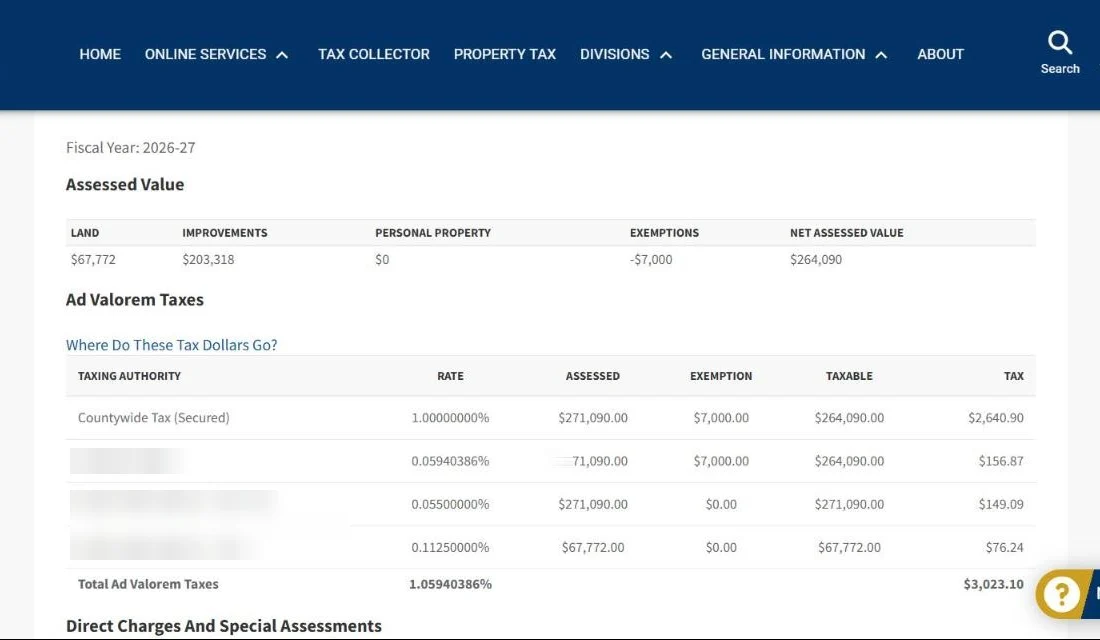
- San Bernardino. On the tax collector’s property tax search, open the current bill. The Exemptions column shows minus $7,000, and the printed bill calls it the homeowner exemption.
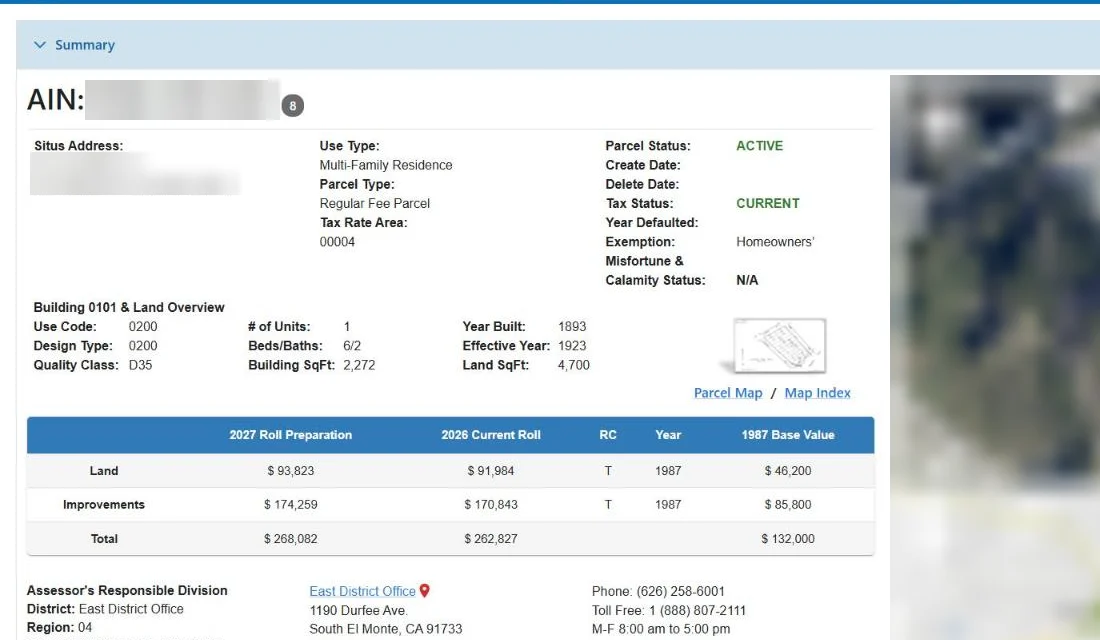
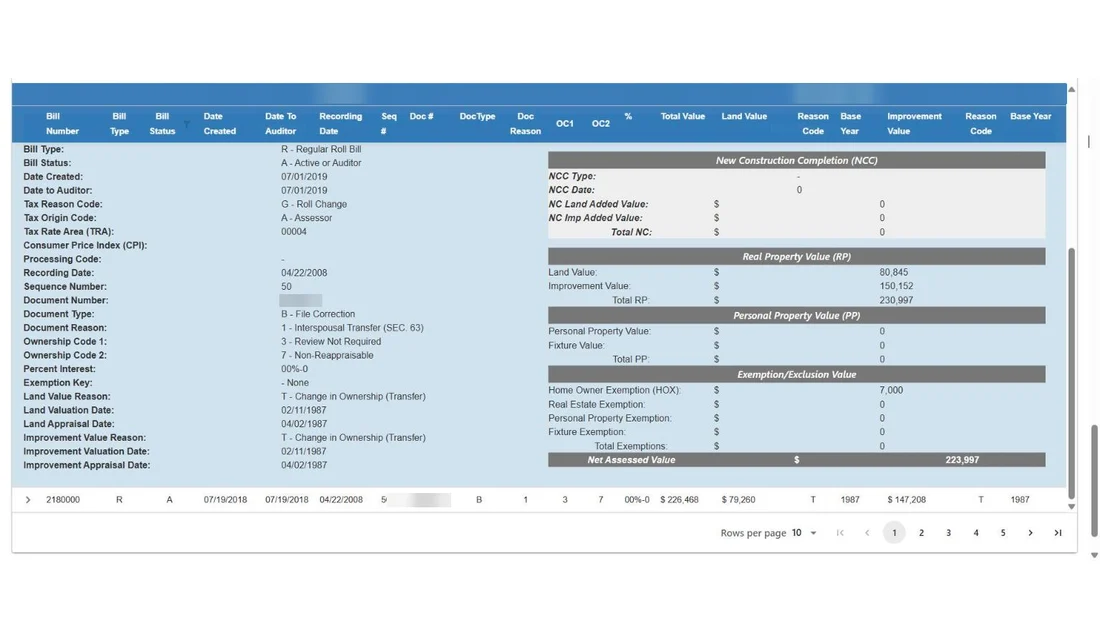
- Los Angeles. The Assessor Portal names the exemption on the parcel summary. Its assessment history goes further. Open a roll year, and the value detail shows a “Home Owner Exemption (HOX)” of $7,000 for that year.
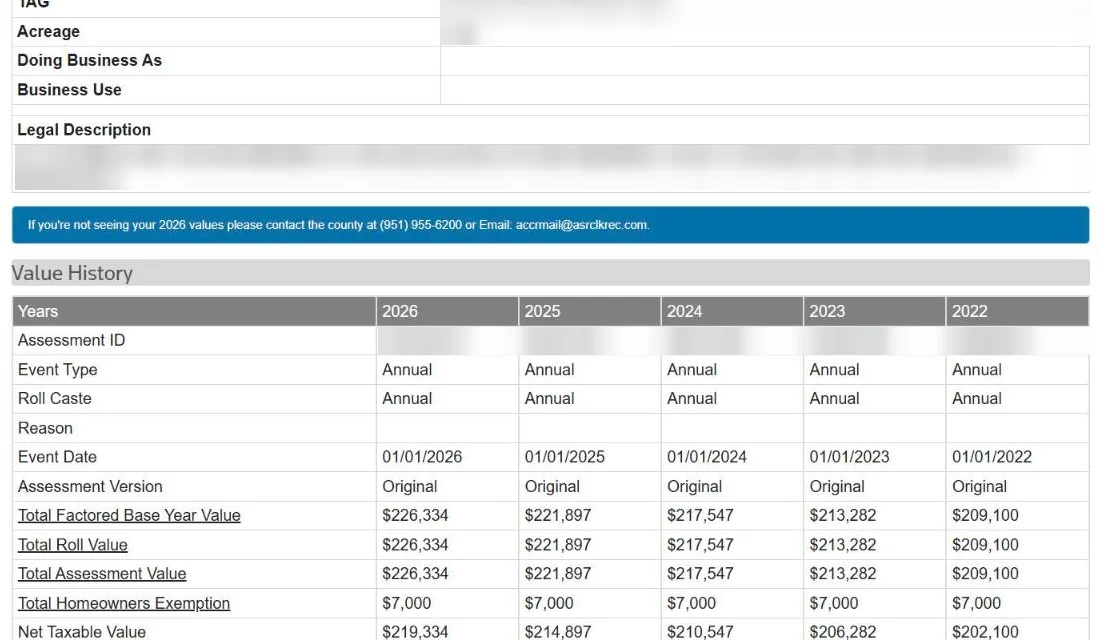
- Riverside. The assessor’s property search has a Value History page that lists the homeowners’ exemption for each of the last five years.
San Diego County prints the exemption in the upper right corner of its bill.
A year-by-year history helps most when the decedent moved out before death. The statute does not limit “primary residence” to where the decedent lived at death (Prob. Code, § 13150, subd. (b)(2)). The history can show that the exemption ran through the years the decedent lived in the house.
This short video walks through all three counties’ websites.
Read the transcript
How do you prove a house was someone’s primary residence? Start with the homeowners’ exemption. I’m Ravi Patel, a California probate attorney. Here’s how to confirm the exemption on three counties’ free websites.
A primary residence petition lets heirs take a house without a full probate. But the court must find that the house was the decedent’s primary residence, and many petitions stall for lack of proof. The homeowners’ exemption gives the strongest single proof, because only an owner who lives in the home as a principal residence can claim it.
You can confirm the exemption on the property tax bill or on the assessor’s parcel page. Each county’s website shows it a little differently. Here are three examples, with the owners’ details blurred for privacy.
In San Bernardino County, start at the tax collector’s website. Search by parcel number or street address, then open the current bill.
Look at the assessed value table. The exemptions column shows minus $7,000. That’s the homeowners’ exemption. The printed bill names it, and its first page makes a good exhibit.
In Los Angeles County, use the Assessor Portal. Search the parcel, and the summary lists the exemption by name.
Scroll down to the assessment history and open a roll year. The value detail shows a homeowners’ exemption of $7,000 for that year. Open earlier years to see how long the exemption ran.
In Riverside County, use the assessor’s property search. Open the property, then Value History. It shows the homeowners’ exemption for each of the last five years.
Whatever the county, save or print the page and date it. If the website leaves doubt, call the assessor. The claim form itself is confidential, but the assessor must keep public records of who received the exemption.
No exemption? Other proof still works: a driver’s license, utility bills, voter registration, and a short declaration from family or neighbors.
For the full guide, with contacts for every county’s assessor and tax collector, see our article at ravilaw.com. Call my office at (510) 443-0443 for a no-cost consultation.
Screens recorded November 16, 2026. The sites may change. Some names are blurred for privacy.
Save each page as an exhibit.
Print the page or save it as a PDF, and note the date you pulled it. For a tax bill, the first page usually carries the exemption line and makes a clean exhibit. Note the mailing address too: a bill mailed to the house adds a second fact in your favor. If you need a document the website doesn’t offer, ask the assessor’s office for a printout of the parcel’s record.
A call to the assessor can settle what the website leaves open.
The law keeps the claim form confidential. But it requires the assessor to mark on the assessment roll each property that receives the exemption, and to keep public records of who received it (Rev. & Tax. Code, § 408, subd. (a)). Ask whether the parcel carried the exemption, and for which years. Some assessors run a unit just for these questions; Alameda County’s homeowners’ exemption unit answers at (510) 272-3770. The chart at the end of this post lists every county’s assessor.
The exemption is strong evidence, but its absence proves nothing.
Many owners never claim it. The Los Angeles County Assessor has stated that “[n]early one in three homeowners in Los Angeles County do not take advantage” of the exemption (L.A. County Assessor press release). The exemption rules also look beyond the last address. They treat an owner confined to a hospital or care facility as still living in the home if the owner intends to return and the home isn’t rented to an outsider (Rev. & Tax. Code, § 218, subd. (b)(4)). An exemption can also stay on the roll after an owner moves out without telling the assessor, so pair it with other proof.
Without an exemption, build the record from ordinary documents.
Gather what shows the decedent lived at the house: tax bills mailed there, a driver’s license or state ID, utility bills and bank statements, voter registration, and the residence address on the death certificate. A short declaration from a family member or neighbor can fill the gaps.
County contacts
This chart lists each county’s assessor and tax collector, drawn from the Board of Equalization’s county contacts list. We updated it to the best of our knowledge as of November 16, 2026.
| County | Assessor | Phone | Tax collector | Phone |
|---|---|---|---|---|
| Alameda | Website | 510-272-3787 | Website | 510-272-6800 |
| Alpine | Website | 530-694-2283 | Website | 530-694-2286 |
| Amador | Website | 209-223-6351 | Website | 209-223-6364 |
| Butte | Website | 530-552-3800 | Website | 530-552-3720 |
| Calaveras | Website | 209-754-6356 | Website | 209-754-6350 |
| Colusa | Website | 530-458-0450 | Website | 530-458-0440 |
| Contra Costa | Website | 925-313-7400 | Website | 925-608-9500 |
| Del Norte | Website | 707-464-7200 | Website | 707-464-7283 |
| El Dorado | Website | 530-621-5719 | Website | 530-621-5800 |
| Fresno | Website | 559-600-3534 | Website | 559-600-3496 |
| Glenn | Website | 530-934-6402 | Website | 530-934-6410 |
| Humboldt | Website | 707-445-7663 | Website | 707-476-2450 |
| Imperial | Website | 442-265-1300 | Website | 442-265-1270 |
| Inyo | Website | 760-878-0302 | Website | 760-878-0312 |
| Kern | Website | 661-868-3485 | Website | 661-868-3490 |
| Kings | Website | 559-852-2486 | Website | 559-852-2479 |
| Lake | Website | 707-263-2302 | Website | 707-263-2234 |
| Lassen | Website | 530-251-8241 | Website | 530-251-8218 |
| Los Angeles | Website | 213-974-3211 | Website | 213-974-2111 |
| Madera | Website | 559-675-7710 | Website | 559-675-7713 |
| Marin | Website | 415-473-7215 | Website | 415-473-6133 |
| Mariposa | Website | 209-966-2332 | Website | 209-966-2621 |
| Mendocino | Website | 707-234-6800 | Website | 707-234-6875 |
| Merced | Website | 209-385-7631 | Website | 209-385-7307 |
| Modoc | Website | 530-233-6218 | Website | 530-233-6223 |
| Mono | Website | 760-932-5510 | Website | 760-932-5480 |
| Monterey | Website | 831-755-5035 | Website | 831-755-5057 |
| Napa | Website | 707-253-4467 | Website | 707-253-4327 |
| Nevada | Website | 530-265-1232 | Website | 530-265-1285 |
| Orange | Website | 714-834-2727 | Website | 714-834-3411 |
| Placer | Website | 530-889-4300 | Website | 530-889-4120 |
| Plumas | Website | 530-283-6380 | Website | 530-283-6260 |
| Riverside | Website | 951-955-6200 | Website | 951-955-3900 |
| Sacramento | Website | 916-875-0700 | Website | 916-874-6622 |
| San Benito | Website | 831-636-4030 | Website | 831-636-4043 |
| San Bernardino | Website | 909-387-8307 | Website | 909-387-8308 |
| San Diego | Website | 619-236-3771 | Website | 877-829-4732 |
| San Francisco | Website | 628-652-8100 | Website | 415-554-4400 |
| San Joaquin | Website | 209-468-2630 | Website | 209-468-2133 |
| San Luis Obispo | Website | 805-461-6143 | Website | 805-781-5831 |
| San Mateo | Website | 650-363-4500 | Website | 866-220-0308 |
| Santa Barbara | Website | 805-568-2550 | Website | 805-568-2920 |
| Santa Clara | Website | 408-299-5500 | Website | 408-808-7900 |
| Santa Cruz | Website | 831-454-2074 | Website | 831-454-2510 |
| Shasta | Website | 530-225-3600 | Website | 530-225-5511 |
| Sierra | Website | 530-289-3283 | Website | 530-289-3286 |
| Siskiyou | Website | 530-842-8036 | Website | 530-842-8340 |
| Solano | Website | 707-784-6210 | Website | 707-784-7485 |
| Sonoma | Website | 707-565-1888 | Website | 707-565-2281 |
| Stanislaus | Website | 209-525-6461 | Website | 209-525-6388 |
| Sutter | Website | 530-822-7160 | Website | 530-822-7117 |
| Tehama | Website | 530-527-5931 | Website | 530-527-4535 |
| Trinity | Website | 530-623-1257 | Website | 530-623-1251 |
| Tulare | Website | 559-636-5100 | Website | 559-636-5250 |
| Tuolumne | Website | 209-533-5535 | Website | 209-533-5544 |
| Ventura | Website | 805-654-2181 | Website | 805-654-3744 |
| Yolo | Website | 530-666-8135 | Website | 530-666-8190 |
| Yuba | Website | 530-749-7820 | Website | 530-749-7840 |
This post is general information, not legal advice. County websites and phone numbers change.