
BlogHeggstad PetitionPractice guide
California probate practice
The Heggstad Petition: A Practice Guide for California Attorneys
The law and procedure of a Heggstad petition under Probate Code section 850, from screening a case to recording the order, with five sample filings built from fictional facts.
Prob. Code, § 850, subd. (a)(3)(B)
Overview
What a Heggstad petition is, and the six steps of a typical case. Each step has its own chapter below.
A Heggstad petition asks the probate court to confirm that an asset still titled in a decedent’s name belongs to the trustee of the decedent’s trust. It is a petition under Probate Code section 850, subdivision (a)(3)(B), and it takes its name from Estate of Heggstad (1993) 16 Cal.App.4th 943, which held that “a written declaration of trust by the owner of real property, in which he names himself trustee, is sufficient to create a trust in that property, and that the law does not require a separate deed transferring the property to the trust.” (Id. at p. 950.)
Statutory references are to the Probate Code unless otherwise noted.
- Fit
The settlor signed a trust, named herself trustee, and described the asset in the trust or its schedule, either specifically or by a general description that title records can make certain. Title never moved.
- File
In the county where the trust is administered (Prob. Code, § 17005, subd. (a)(1)). If the trustee administers it outside California, the civil venue rules apply instead (subd. (c)).
- Notify
At least 30 days before the hearing: service in the manner of a summons on anyone who claims an interest in, holds title to, or has possession of the property, and on anyone else whose interest would be affected; delivery under section 1215 to the trustees and beneficiaries. The court cannot shorten the time (Prob. Code, §§ 851, 17203).
- Prove
The trust and its schedule, the vesting deed and every later recorded instrument, the death certificate, the section 16061.7 notice, and whatever bridges a gap in the name or the description.
- Order
A self-contained order with the street address, assessor’s parcel number and full legal description, or the institution and account identifiers, written for the recorder or the bank that will read it.
- Record
Record a certified copy with a cover sheet and the county’s PCOR. The change in ownership statement (BOE-502-D) was due within 150 days after the death (Rev. & Tax. Code, § 480).
The typical filing packet
The documents most Heggstad petitions include, in the order they are used. The pages shown are from Sample 1.
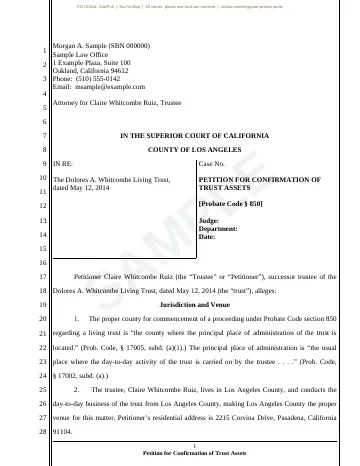 Verified petition
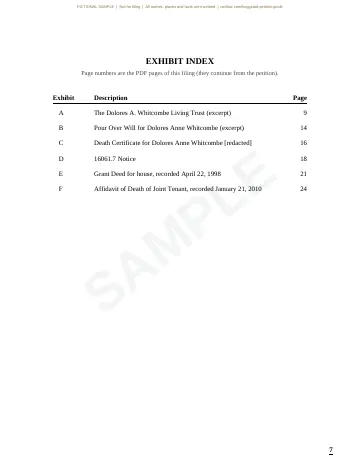 Exhibit index
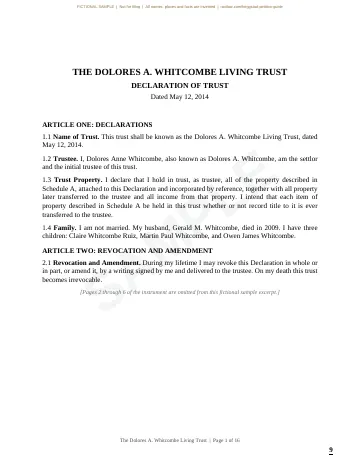 Trust excerpt
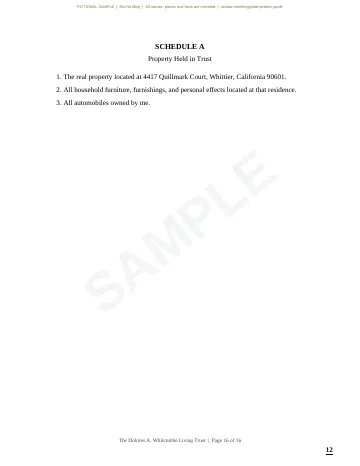 Schedule A
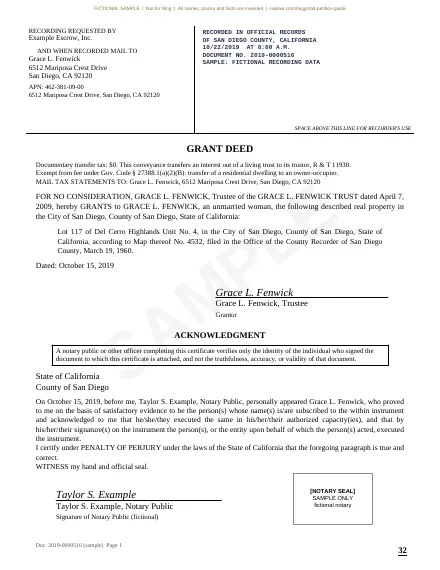
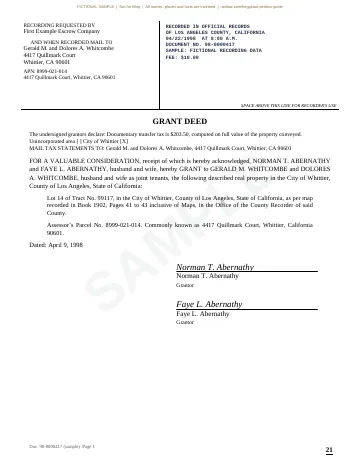 Vesting deed
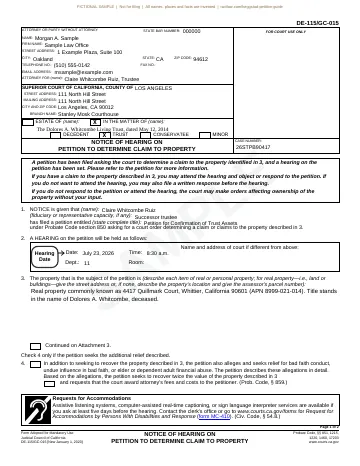 DE-115 notice
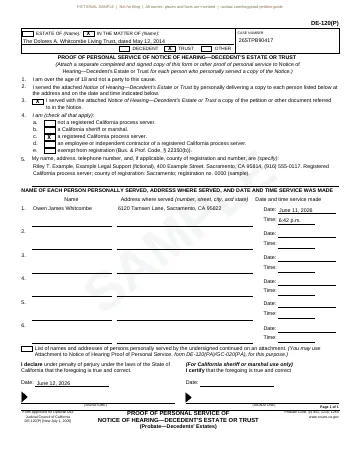 DE-120(P) proof
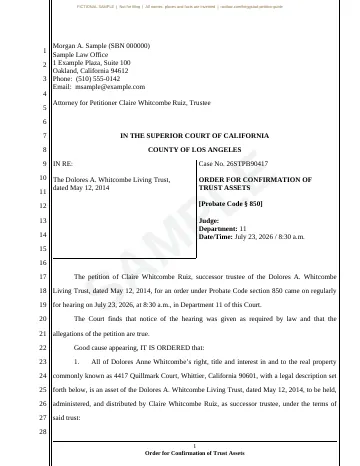 Proposed order
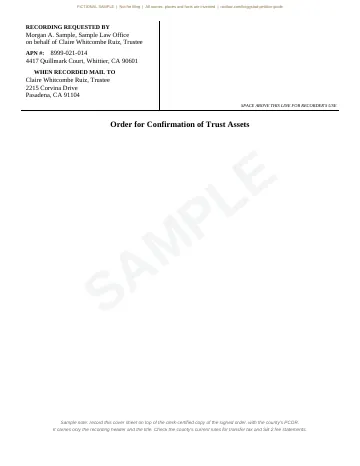 Recording cover sheet
Five sample petitions
Each sample is a complete filing built from fictional facts: the verified petition, exhibits with pincites to the filing’s own page numbers, notice papers and proofs of service, the proposed order and, for real property, a recording cover sheet. Each begins with practice notes explaining the drafting choices.
Fictional, for the legal community. Every person, trust, property, address, account, parcel number, case number and recording number in these samples is invented, and every page is marked SAMPLE. They are not forms approved by any court and they are not legal advice. Judicial Council and county forms appear as they stood in October 2026. Check current law, rules, forms and your own facts before filing anything.
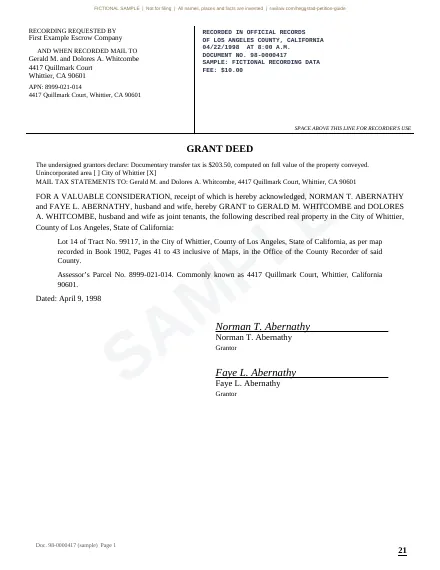
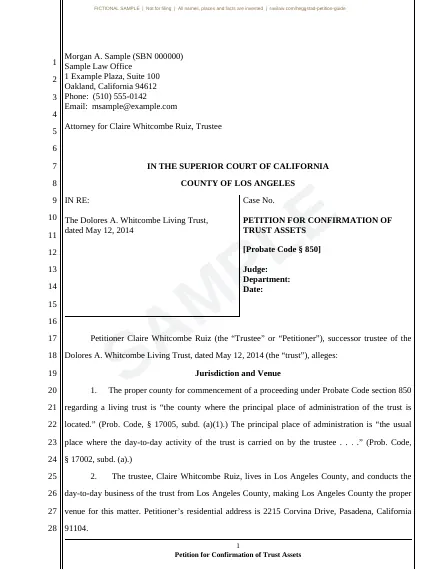
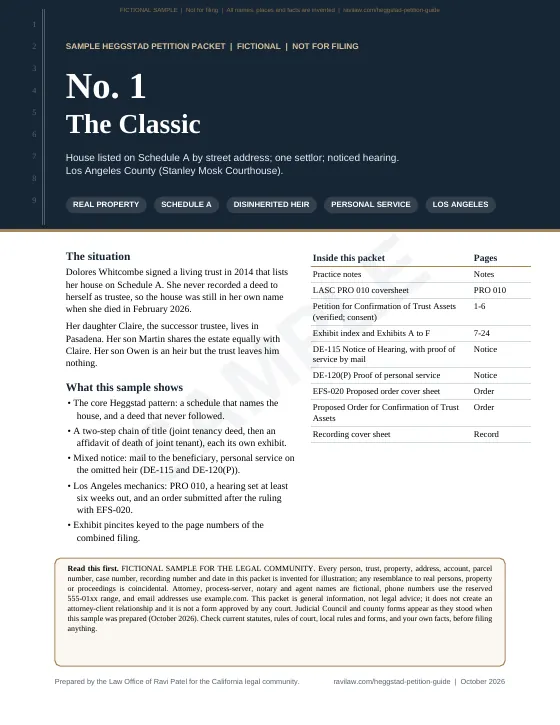
No. 1 Los Angeles County
The Classic
A house listed on Schedule A by street address, one settlor, and an heir the trust leaves out.
- The PRO 010 coversheet and district certificate
- Mail notice to a beneficiary and personal service on the omitted heir (DE-115, DE-120(P))
- Exhibit pincites keyed to the filing’s own page numbers
- An order submitted after the ruling with EFS-020
No. 2 Alameda County
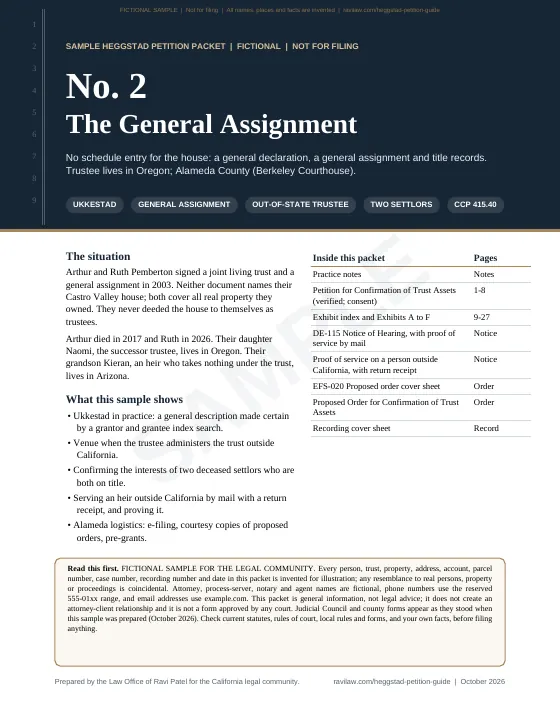
The General Assignment
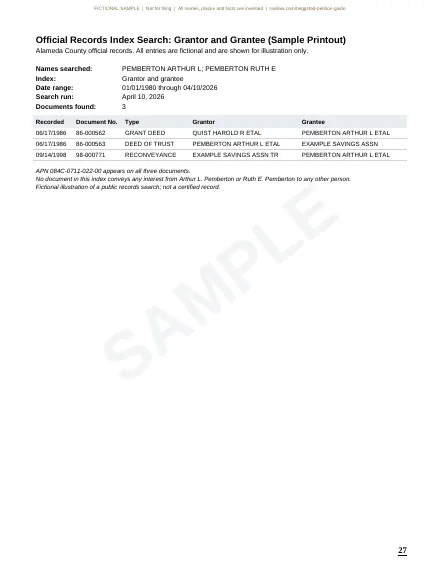
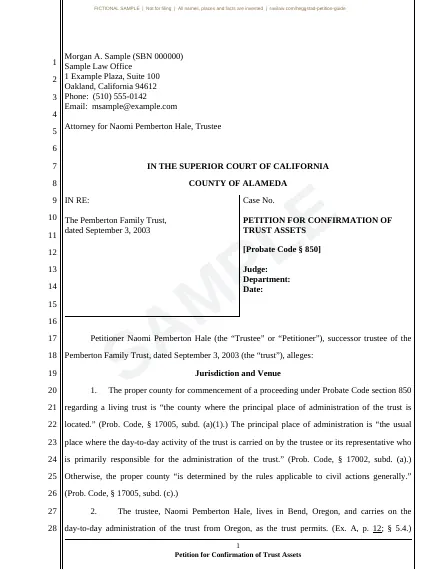
No schedule entry at all: a general declaration, a general assignment, and a grantor and grantee index search.
- Ukkestad in practice, with the Kucker footnote
- Venue when the trustee administers the trust from Oregon
- Two deceased settlors still on title
- Serving an heir in Arizona by mail with a return receipt
No. 3 Orange County
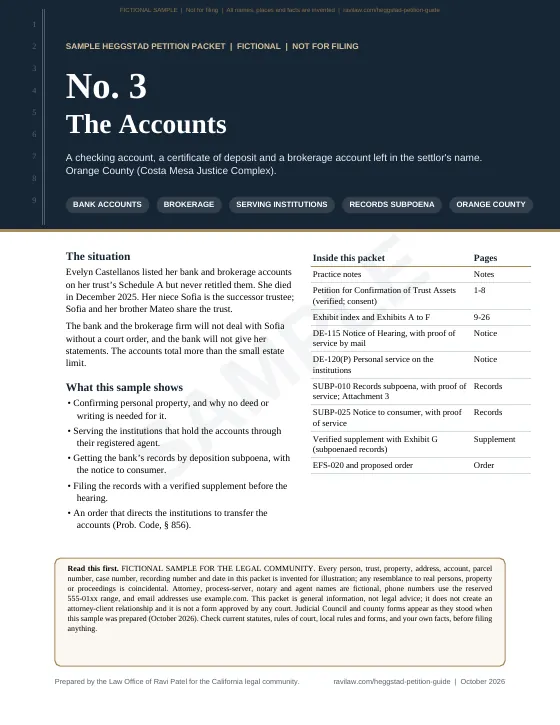
The Accounts
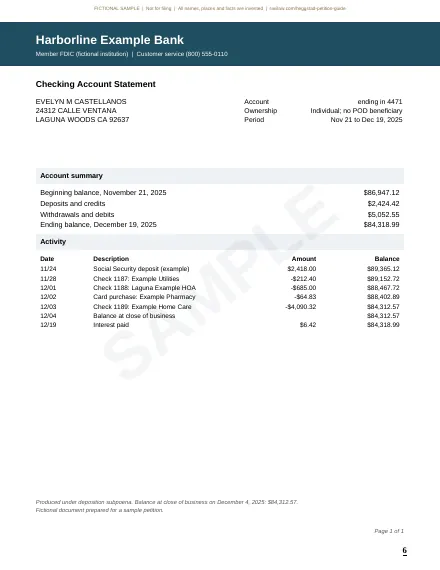
A checking account, a certificate of deposit and a brokerage account that never left the settlor’s name.
- Serving the bank and the brokerage through their registered agent
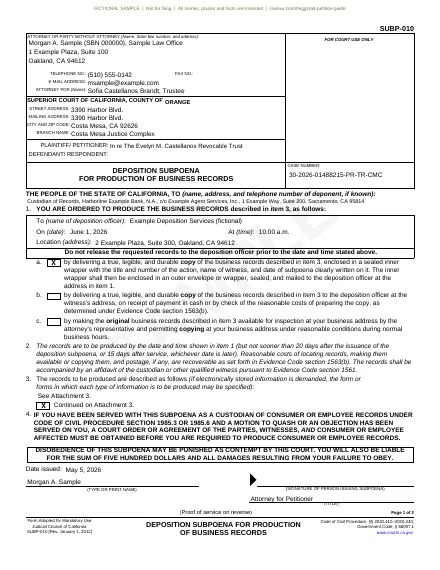
- A records subpoena (SUBP-010) with the notice to consumer (SUBP-025)
- A verified supplement filing the subpoenaed statements
- An order directing the institutions to transfer (Prob. Code, § 856)
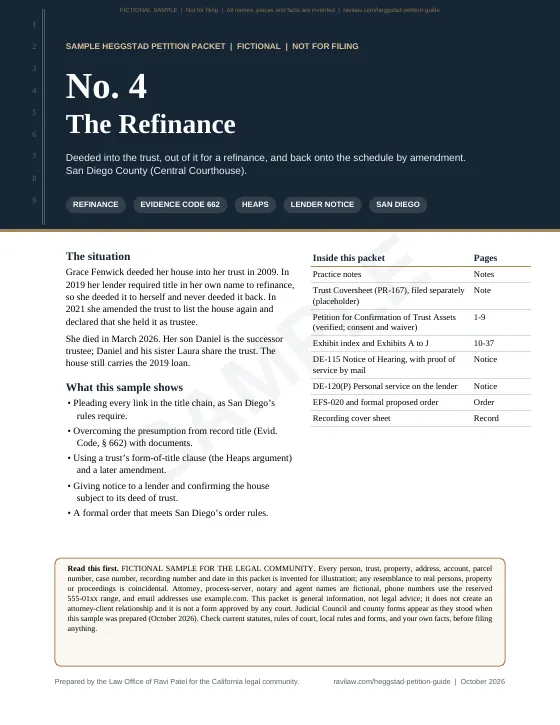
No. 4 San Diego County
The Refinance
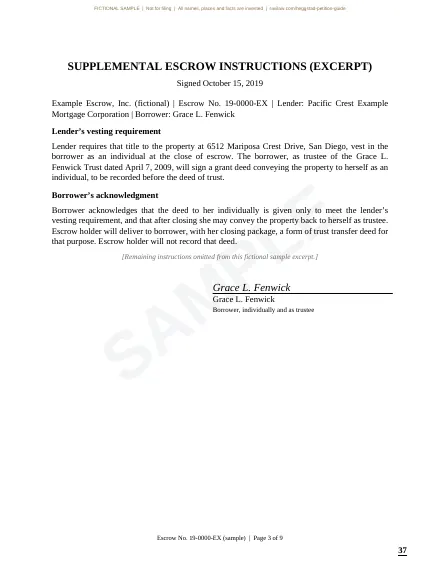
Into the trust in 2009, out for a refinance in 2019, and back onto the schedule by amendment in 2021.
- The full title chain San Diego’s rules ask for
- Overcoming the presumption from record title (Evid. Code, § 662)
- Notice to the lender, and an order subject to its deed of trust
- A formal order that meets San Diego’s order rules
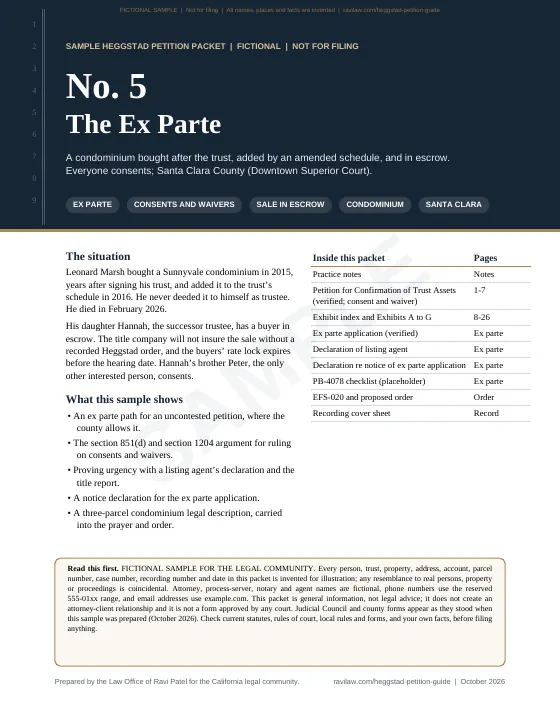
No. 5 Santa Clara County
The Ex Parte
A condominium in escrow, a title company that wants an order, and consents from everyone entitled to notice.
- An ex parte application on consents and waivers
- The section 851(d) and section 1204 argument
- A listing agent’s declaration and a notice declaration
- A three-parcel condominium legal description, carried into the order
Download the samples
Enter your name and email to download the samples: five PDFs, or one zip file with all five. Each PDF is bookmarked, and its page labels match the pincites.
We store your name, email, your answer to the role question and the acknowledgment below, the page, and the date, in the firm’s own database. We do not sell or share it. Updates are optional and you can opt out at any time. See the privacy policy.
Downloads
Preview only: nothing was sent or saved. On the live site the form stores the entry and then shows these links.
Questions or corrections: staff@ravilaw.com.
Prob. Code, §§ 15200, 15206, 15207
When a Heggstad petition applies
The legal basis for the petition, four questions for screening a case, and the situations that call for a different procedure.
The legal basis
An owner can create a trust by declaring that she holds her property as trustee (Prob. Code, § 15200, subd. (a)). For real property, the declaration has to satisfy the trust statute of frauds, which a written instrument signed by the trustee does (Prob. Code, § 15206, subd. (a)). Heggstad held that a signed declaration of trust with a schedule listing the property did both, so no deed was needed. (Estate of Heggstad, supra, 16 Cal.App.4th at pp. 948-951.) A section 850 petition is the procedure that turns that conclusion into an order a recorder, a title insurer or a bank will act on.
Four screening questions
-
Was the owner the trustee?
The declaration theory works because the owner and the trustee are the same person. Ukkestad calls this the first requirement: “the owner of real property is the settlor creating the trust with himself or herself as the trustee.” (Ukkestad v. RBS Asset Finance, Inc. (2015) 235 Cal.App.4th 156, 160.) If someone else was the initial trustee, look instead for language in the signed instrument that transfers the property to that trustee. In Carne v. Worthington (2016) 246 Cal.App.4th 548, 551, a trust instrument stating “I transfer to my Trustee the property listed in Schedule A” conveyed the listed property without a deed. Where a trust named people other than the settlors as trustees, the court in Osswald found Heggstad distinguishable. (Osswald v. Anderson (1996) 49 Cal.App.4th 812, 820.)
-
Does a signed writing describe the asset?
A street address or parcel number on a schedule is the easy case. A general description, such as “all of my real property,” can satisfy the statute of frauds when extrinsic evidence such as public title records makes it certain. (Ukkestad, supra, 235 Cal.App.4th at pp. 162-164.) A declaration that refers to a schedule that was never attached is not enough. (Osswald, supra, 49 Cal.App.4th at p. 818.) Sample 2 builds the general-description case.
-
Did a later transfer take it out of the trust?
A later sale, a revocation, or a deed out of the trust raises the question whether the asset left the trust. Record title in the decedent’s individual name brings in the presumption that she held the full beneficial title, which only clear and convincing proof overcomes. (Evid. Code, § 662; Carne, supra, 246 Cal.App.4th at pp. 556-558.) Trust terms that allow title to be held in any form help; Heaps relied on them to hold that taking title outside the trust did not, by itself, remove the asset. (Heaps v. Heaps (2004) 124 Cal.App.4th 286, 291-292.) Sample 4 is the refinance version of this problem.
-
Does survivorship or a beneficiary designation control?
A surviving joint tenant takes by right of survivorship, and a payable-on-death or transfer-on-death designation usually controls the asset it covers. Those assets are rarely Heggstad candidates, and a petition that ignores them invites an objection. Check title and beneficiary designations before you draft.
Personal property
The trust statute of frauds reaches only real property (Prob. Code, § 15206). A trust of personal property can rest on the owner’s written declaration. Even an oral trust of personal property can be proved, but only by clear and convincing evidence, and the settlor’s oral declaration, standing alone, is not enough. (Prob. Code, § 15207, subds. (a) & (b).) In practice the petition still attaches the schedule or other writing that names the account; Sample 3 shows how.
Tool
Screening tool
Answer a few questions about one asset to see which procedure usually fits, and why. The result is a starting point for your own analysis, not a conclusion.
Prob. Code, §§ 17002, 17005
Venue
For a living trust, venue is the county where the trustee administers the trust, not where the property is or where the settlor lived. Different rules apply when the trustee is outside California.
The principal place of administration
For a proceeding under the Trust Law concerning a living trust, the proper county is “the county where the principal place of administration of the trust is located.” (Prob. Code, § 17005, subd. (a)(1).) The principal place of administration is “the usual place where the day-to-day activity of the trust is carried on by the trustee or its representative who is primarily responsible for the administration of the trust.” (Prob. Code, § 17002, subd. (a).) If that place cannot be determined, it is a sole trustee’s residence or usual place of business; with cotrustees, the residence or usual place of business of any of them, as they agree or, if they do not agree, any of them. (Prob. Code, § 17002, subd. (b).)
Section 17005 speaks to proceedings under the Trust Law (Prob. Code, § 15000 et seq.), and Heggstad itself arose on a section 17200 petition (Estate of Heggstad, supra, 16 Cal.App.4th at pp. 951-952), so many practitioners cite section 17200 alongside section 850 in the caption. Either way, plead facts, not the conclusion. Say where the trustee lives and where she does the trust’s work: where she keeps the records, pays the bills and deals with the property. Sample 1 shows a two-paragraph venue allegation.
When the trustee is outside California
If the trust is administered outside the state, subdivision (a)(1) points to no California county, and the proper county “is determined by the rules applicable to civil actions generally.” (Prob. Code, § 17005, subd. (c).) For real property, that means the county where the property sits: the superior court there “is the proper court for the trial” of an action “for the determination in any form” of a right or interest in real property. (Code Civ. Proc., § 392, subd. (a)(1).)
Add the estate-side ground as an alternative. Section 850 also allows a petition “[w]here the decedent died in possession of, or holding title to, real or personal property, and the property or some interest therein is claimed to belong to another” (Prob. Code, § 850, subd. (a)(2)(C)), and the proper county for proceedings concerning the estate of a California domiciliary is “the county in which the decedent was domiciled, regardless of where the decedent died.” (Prob. Code, § 7051.) For a decedent who was not domiciled in California, section 7052 looks to the county where the decedent died if property is there, and otherwise to any county where property is located. For accounts and other personal property held by an out-of-state trustee, the domicile ground is often the cleaner one. Sample 2 pleads both grounds for a trustee in Oregon.
Tool
Venue finder
Enter where the trustee administers the trust, where the property is, and where the decedent lived. The tool gives the county and a venue paragraph with authority.
Prob. Code, §§ 851, 1215, 17203
Notice
Who receives notice of the hearing, how it is given, and when service is complete. The court cannot shorten the 30-day notice period.
Section 851 supplies the framework, and for a trust it incorporates section 17203. Together they require notice of the hearing and a copy of the petition at least 30 days before the hearing, and they do not let the court shorten the time. (Prob. Code, §§ 851, subds. (a), (b) & (d), 17203, subds. (a) & (b).) Use form DE-115, the mandatory notice of hearing for petitions to determine a claim to property; it carries the content section 851, subdivision (c), requires, including the street address of real property and a statement that interested persons may respond.
Who receives notice
| Person | Method | Authority |
|---|---|---|
| The trustee, personal representative, conservator or guardian, as appropriate (if not the petitioner) | Manner of a summons | Prob. Code, § 851, subd. (a)(1) |
| Anyone claiming an interest in, or having title to or possession of, the property: co-owners, occupants, lenders of record, the bank holding an account | Manner of a summons | Prob. Code, § 851, subd. (a)(2) |
| All trustees and all beneficiaries | Delivery under section 1215, usually first-class mail | Prob. Code, §§ 851, subd. (b)(3), 17203, subd. (a)(1) & (2) |
| The Attorney General, if the petition relates to a charitable trust subject to the Attorney General’s jurisdiction | Delivery under section 1215 | Prob. Code, § 17203, subd. (a)(3) |
| Anyone else whose right, title or interest would be affected, such as an heir who is not a beneficiary | Manner of a summons | Prob. Code, § 17203, subd. (b) |
| The decedent herself, because title is in her name: if she has been dead at least 40 days, no personal representative has been appointed, and her interest has not passed to anyone else, notice may instead go to her heirs and devisees and anyone named as executor in her will, so far as known, and to any guardian or conservator serving at her death | As for the decedent | Prob. Code, § 17203, subd. (c) |
Methods, and when service is complete
| Method | Complete | Mail or serve by | Proof |
|---|---|---|---|
| First-class mail (Prob. Code, § 1215) | On deposit in the mail; “[t]he period of notice is not extended” (§ 1215, subd. (a)(4)) | 30 days before | DE-115, page 2 |
| Personal delivery (Code Civ. Proc., § 415.10) | On delivery | 30 days before | DE-120(P) |
| Substituted service (Code Civ. Proc., § 415.20) | 10th day after the follow-up mailing | 40 days before | Declaration with diligence facts (Code Civ. Proc., § 417.10) |
| Notice and acknowledgment (Code Civ. Proc., § 415.30) | When the acknowledgment is signed, if returned | Early enough to get it back | Signed POS-015 |
| Service by mail on a person outside California, in the manner of a summons (Code Civ. Proc., § 415.40) | 10th day after mailing | 40 days before | Signed return receipt or other proof of delivery (Code Civ. Proc., § 417.20, subd. (a)) |
| Corporation (Code Civ. Proc., § 416.10) | By whichever method is used, on its agent for service or an officer | 30 or 40 days before | DE-120(P) naming the person served |
Count backward from the hearing, excluding the hearing day, and count any added days for the method of service backward from there. (Code Civ. Proc., § 12c.) When the last day falls on a weekend or a court holiday, treat the preceding court day as the deadline. DE-115’s own proof of service covers mail only; the form directs you to DE-120(P) for personal service. Sample 1 uses both, and Sample 2 proves service outside California.
Tool
Notice deadline calculator
Enter the hearing date. The calculator counts backward under section 12c, moves a deadline that falls on a weekend or a California court holiday to the preceding court day, and shows the deadlines on a timeline.
When an address is unknown
If the address of someone entitled to delivery under section 1215 is unknown, notice is given as the court requires under Code of Civil Procedure section 413.30, unless the court dispenses with it. (Prob. Code, § 1212.) For someone who must be served in the manner of a summons, such as an heir standing in for the decedent, ask for an order under Code of Civil Procedure section 413.30 or for publication under section 415.50. Either way, document a diligent search before you ask (Cal. Rules of Court, rule 7.52), and ask early, because the order you get may require publication or another step that takes time.
Waivers and consents
A person may waive notice “by a writing signed by the person or the person’s attorney and filed in the proceeding.” (Prob. Code, § 1204.) A consent that also supports the relief tells the examiner the matter is uncontested. In San Diego, a waiver of notice in a section 850 proceeding must include the notice content section 851, subdivision (c), requires (Super. Ct. San Diego County, Local Rules, rule 4.5.2(G)); Sample 4 shows the language.
Prob. Code, §§ 850, subd. (b), 1021, 1023
Verification, exhibits and declarations
An uncontested petition is usually decided on the papers, so each allegation should be supported by an exhibit the examiner can find in the same PDF.
Verification
A petition must be verified, ordinarily by the petitioner. (Prob. Code, § 1021, subds. (a)(1) & (b)(1).) The attorney may verify when the petitioner is absent from the county or otherwise unable to, unless the petitioner is a fiduciary appointed in the proceeding (Prob. Code, § 1023), but an attorney’s verification is weak evidence of facts the attorney does not know; Contra Costa says so in its rules (Super. Ct. Contra Costa County, Local Rules, rule 7.53). Have the trustee sign. A trustee who signs outside California should declare under penalty of perjury “under the laws of the State of California” (Code Civ. Proc., § 2015.5); Sample 2 has a verification signed in Oregon.
Contents of the petition
The petition “shall set forth facts upon which the claim is based.” (Prob. Code, § 850, subd. (b).) In practice that means the facts that let the court find each element without inference: who created the trust and when, who the trustee was, what the writing says about this asset, how title came to the decedent and where it sits now, who takes under the trust, who the heirs are, and who was given notice and how.
CAPTION: Petition for Confirmation of Trust Assets [Probate Code § 850]
  (name the petitioner and capacity on page one, e.g., "Jane Doe, Trustee")

1. Jurisdiction and venue
   Principal place of administration (Prob. Code, §§ 17005, subd. (a)(1), 17002)
   Facts: where the trustee lives and runs the trust

2. The trust
   Date, settlor, initial trustee; the declaration and schedule (pincite)
   Death, irrevocability, successor trustee, beneficiaries (pincite)
   Section 16061.7 notice: date served (exhibit)

3. The trust asset(s)
   For each asset: how and when the decedent took title (vesting deed)
   Every later instrument affecting title, in order
   Name variances, bridged by the trust's own recitals
   Encumbrances and occupancy

4. Notice
   Heirs; beneficiaries; trustees; persons claiming an interest,
   holding title or in possession; Attorney General (if any)
   Table: name, address, relationship, method of notice

5. Request
   Probate Code section 850, subdivision (a)(3)(B)
   Heggstad (and Ukkestad, Heaps, Carne, as the facts require)
   Application to these facts

6. Prayer (self-contained)
   Street address, APN and full legal description, or institution
   and account identifiers; "subject to" any encumbrance; § 856
   directions to a holder, if needed

Signature; verification; consents and waivers
Exhibits
- The trust. At least the pages that create the trust, name the trustees, state the distribution and describe the property, with the signature and acknowledgment pages. Some courts want the whole instrument; San Diego requires a complete copy filed separately with a coversheet (Super. Ct. San Diego County, Local Rules, rule 4.3.3(J)).
- Title documents. The deed by which the decedent acquired title and every later recorded instrument that touched it. San Diego requires the acquisition deeds and a statement of all encumbrances (rule 4.3.11). A grantor and grantee index search can prove a negative, as in Sample 2.
- Death certificates. Redact the Social Security number to the last four digits, and show only the last four digits of any financial account number anywhere in the filing. (Cal. Rules of Court, rule 1.201.)
- The section 16061.7 notice and its proof of service. It shows the trustee has done the basics, and the current warning language matters (Prob. Code, § 16061.7, subd. (h)).
- Institution records. Statements, a date-of-death balance letter, or the bank’s refusal letter. See chapter 7.
When to add a declaration
The verified petition and the documents usually carry an uncontested matter. Add a declaration when the record has a gap a document cannot fill: a name on the deed that differs from the trust, a schedule page that is missing, a refinance history, occupancy, or a family tree with predeceased children. State evidentiary facts on personal knowledge, not conclusions. An escrow officer or a title officer can be the right declarant for a transaction history; a family member for the family tree.
Checklist
Before you file
Checked items are saved in this browser.
Prob. Code, §§ 851.1, 1000; Code Civ. Proc., § 1985.3
Bank and brokerage records
An institution often will not retitle an account without a court order, and the court needs proof of the account before it will make one. This chapter covers informal requests, records subpoenas and transfer orders.
Records the trustee can obtain
Before anything is filed, the trustee can usually assemble enough to plead the account: mailed statements, year-end tax summaries, a closing letter, or a date-of-death balance letter. Many institutions will confirm the balance and the form of ownership to a successor trustee who sends a death certificate and a certification of trust (Prob. Code, § 18100.5), even when they will not retitle the account. Ask for a letter that states the registration, any payable-on-death or transfer-on-death designation, and the balance on the date of death. Sample 3 pleads the accounts from year-end summaries and two institution letters.
Records subpoenas
Civil discovery rules apply in probate proceedings. (Prob. Code, § 1000, subd. (a).) In a section 850 proceeding, the petitioner may take discovery from anyone who received notice of the hearing under section 851, subdivision (a), including the institution holding the account, on the Civil Discovery Act’s time periods, which “commence to run upon service of the petition and notice of hearing.” (Prob. Code, § 851.1.) For other nonparties, those periods run from service “upon all parties entitled to notice.” (Prob. Code, § 1000, subd. (b).) For a plaintiff, the Act’s waiting period for depositions is 20 days after service (Code Civ. Proc., § 2025.210, subd. (b)); the cautious course treats a records subpoena the same way. The safer sequence is to file, serve everyone entitled to notice, wait 20 days, and then issue the subpoena.
- Day 0
Petition and notice served on everyone entitled to notice. Set the hearing far enough out for what follows.
- Day 20 or later
Issue the deposition subpoena for business records (form SUBP-010), with an Attachment 3 that describes the records: statements around the date of death, the date-of-death balance, signature cards and any beneficiary designation. The same day, serve the notice to consumer (form SUBP-025) with a copy of the subpoena.
- 5 days later (10 if mailed)
Serve the subpoena on the custodian, with the proof of service of the notice to consumer. The notice must precede service on the custodian by at least five days, plus five more if mailed within California. (Code Civ. Proc., §§ 1985.3, subd. (b)(3), 1013, subd. (a), 2020.410, subd. (d).)
- Production date
No earlier than 20 days after issuance or 15 days after service of the subpoena, whichever is later (Code Civ. Proc., § 2020.410, subd. (c)), and at least 10 days after the notice to consumer, plus five if mailed (§ 1985.3, subd. (b)(2)). The custodian delivers the records with a declaration under Evidence Code sections 1561 and 1562.
- Before the notes
File a verified supplement attaching the records, with account numbers reduced to the last four digits (Cal. Rules of Court, rule 1.201). File it before the probate notes are finalized.
Transfer orders under section 856
When the court is satisfied a transfer should be made, it “shall make an order authorizing and directing . . . the person having title to or possession of the property to execute a conveyance or transfer to the person entitled thereto, or granting other appropriate relief.” (Prob. Code, § 856.) An order that names the institution and directs the transfer to the trustee avoids a second round of requests to the institution.
Prob. Code, § 851, subd. (a)(2); Code Civ. Proc., § 416.10
Serving banks, brokerages and lenders
An institution holding an account, or a lender with a recorded deed of trust, is served in the manner of a summons, through its agent for service of process.
Which institutions are served
A bank or brokerage firm holding an account in the decedent’s name has possession of the property, and a lender with a recorded deed of trust claims an interest in it. Both get notice of the hearing and a copy of the petition in the manner of a summons, at least 30 days before the hearing. (Prob. Code, § 851, subd. (a)(2).)
Method of service
For a corporation, deliver the papers to its designated agent for service of process, or to an officer, general manager or other person authorized to receive service. (Code Civ. Proc., § 416.10, subds. (a) & (b).) Other entity types have their own service rules (Code Civ. Proc., §§ 416.10 to 416.50; Corp. Code, § 17701.16 [limited liability companies]).
Finding the agent for service of process
The Secretary of State’s California Business Search, at bizfileonline.sos.ca.gov, shows each registered entity’s status, its agent for service of process and the agent’s address, and the officers named in its statements of information. The search is free. Run it right before you send the papers to the process server, not from an old file.
Search the exact legal name.
Use the name on the account statement, the deed of trust or the latest recorded assignment of it, not the brand on the branch sign. For a lender, look for a recorded assignment first: the current beneficiary may not be the lender that made the loan. If nothing turns up, try the variations, such as “National Association” and “N.A.”, or “Inc.” and “LLC”.
Pick the active entity.
A search usually returns several entities with nearly the same name: an older corporation, a newer LLC with the same words, a company that merged into another years ago. Serve the one whose status is Active and whose exact name and entity type (corporation or LLC) match your institution. If the only match shows Merged Out or Converted Out, find the entity that survived and look that one up.
Copy the agent exactly.
Open the record and read the agent block. Most institutions use a registered corporate agent, such as CT Corporation System or CSC Lawyers Incorporating Service, and the process server delivers to that agent’s office. Copy the agent’s name and address word for word, suite number included, into your instructions to the server and later into the proof of service.
Keep a dated copy.
Agents change. Save or print the record with the date you checked it, so the file shows where the address came from if service is ever questioned.
No active agent?
If the agent has resigned, cannot be found at the listed address, or the institution is not on the site at all, serve an officer or another person authorized to receive service (Code Civ. Proc., § 416.10, subd. (b)); the record lists the officers. If that fails too, ask the court for an order allowing another method, well before the hearing.
Prove service on DE-120(P), naming the entity, the person who accepted the papers, that person’s title, and the address. Orange County requires the petition, a supplement or the proof of service to include those details. (Super. Ct. Orange County, Local Rules, rule 602.01.) Sample 3 serves a bank and a brokerage firm through their registered agent; Sample 4 serves a lender.
Lenders: confirm the asset subject to the lien
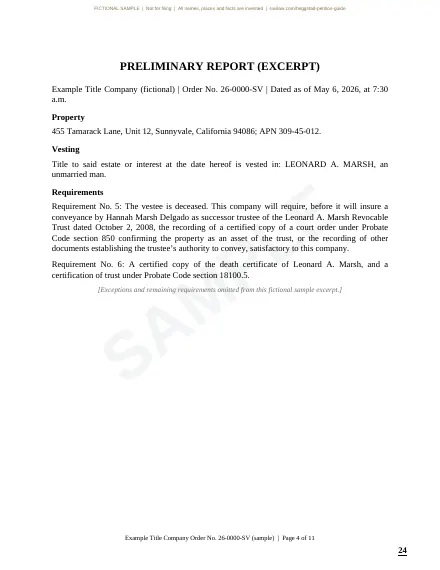
A Heggstad order does not change the lender’s security, and the petition should say so. Plead the deed of trust in the asset section, give the lender notice, and ask the court to confirm the property as a trust asset “subject to” the recorded deed of trust by date and document number. The prayer in Sample 4 does this.
If a foreclosure sale is already scheduled, the petition alone will not stop it on time. That situation calls for separate emergency relief.
Prob. Code, § 856; Cal. Rules of Court, rule 3.1312
The proposed order
The recorder, the title officer and the bank will rely on the order without reading the petition, so the order has to be complete on its own.
Contents of the order
- It stands alone. Identify the petition, the petitioner and capacity, the trust by name and date, and the hearing date, time and department. Do not incorporate the petition by reference.
- Findings. Notice was given as required by law and the allegations are true. Where record title raised the section 662 presumption, add a finding that clear and convincing evidence shows the property is trust property.
- The asset, described for its reader. For real property: the street address, the assessor’s parcel number and the full legal description, with every parcel of a condominium description. For accounts: the institution and the last four digits.
- The operative language. The decedent’s right, title and interest in the asset is an asset of the trust, to be held, administered and distributed by the trustee under the terms of the trust; subject to any recorded encumbrance; and, where a holder must act, a direction to transfer (Prob. Code, § 856).
- A signature page with text on it. Keep substantive text above the judge’s signature and nothing after it.
| County | Rule | What it requires |
|---|---|---|
| Los Angeles | 4.29, 4.29(d) | Submit the order after the ruling. At least two lines of substantive text above the signature, nothing after it; real property orders include the legal description, street address and APN. |
| Orange | 601.14 | Submit separately, complete in itself, with the hearing date and property descriptions; the signature line ends the order and is never alone on a page. |
| San Diego | 4.7.1(B), 4.7.2 | In uncontested matters the minute order is the order unless a formal order is submitted four court days ahead. A formal order opens with the petition’s title and ROA number, the hearing, the department and the judge’s name, with two lines of text on the signature page. |
| San Francisco | 14.7.A | Lodge the proposed order at least 10 court days before the hearing, drafted as if granted; do not leave the signature line alone on the last page. |
| Santa Clara | 2.B.1, 2.B.2 | Submit at least four court days before; show the hearing date and department; put order text on the signature page. |
| Sacramento | 4.15(A), 4.16 | Name the persons affected and describe property by APN and legal description; lodge five court days before in person, eight by mail. |
| Contra Costa | 7.54, 7.101 | Submit at least three court days before, drafted as granted, with the full legal description and APN. |
| Alameda | 7.10, 7.2(g) | For a pre-grant, have the proposed order on file at least two days before, and deliver a paper courtesy copy of an e-filed order to the department. |
Every county’s rules are in County local rules (chapter 14). When e-filing, attach the order to form EFS-020 and e-mail an editable copy to the address the court designates, copying all parties. (Cal. Rules of Court, rule 3.1312(c).)
Tool
Order builder
Fill in the facts and copy the recital, findings and operative paragraphs into your pleading-paper template. Nothing you type leaves this page.
Prob. Code, §§ 851, subd. (d), 1204
Ex parte and expedited relief
When an escrow or other deadline cannot wait for a regular hearing date, the options depend on consents and waivers, on section 851, subdivision (d), and on the county.
Section 851, subdivision (d)
Section 851, subdivision (d), says: “The court may not shorten the time for giving the notice of hearing under this section.” So the court cannot shrink the 30 days. The argument for ruling sooner is that it does not have to: when everyone entitled to notice has waived it in writing (Prob. Code, § 1204), no notice remains to be given, so granting the petition early shortens nothing. The court is only deciding an uncontested petition before its scheduled date. Sample 5 makes the argument in both the petition and the ex parte application.
That argument needs every person entitled to notice, including heirs who stand in for the decedent (Prob. Code, § 17203, subd. (c)), and anyone claiming an interest in the property. One missing signature ends it. File the petition with an ordinary hearing date as a fallback.
The contrary view in some courts
Not every court accepts the argument. Some treat section 851 as meaning that a section 850 petition can never be heard sooner than 30 days after it is filed, whatever has been waived; in our experience Riverside is one of them. As far as we know, no appellate court has decided the question either way. We make the argument in every ex parte application anyway, because the statute’s text supports it: section 851 counts its 30 days back from the hearing to the service of notice, not from the filing of the petition, and section 1204 lets each person entitled to that notice waive it. Where a court takes the other view, the fallback hearing date is what you will get, so ask for the earliest date the 30 days allow.
Probate Code section 851, subdivision (d), does not prevent the Court from granting the petition now, because the written waivers of every person entitled to notice leave no notice of hearing to give.
Section 851 requires notice of the hearing on a section 850 petition to be served at least 30 days before the hearing, and subdivision (d) provides that “[t]he court may not shorten the time for giving the notice of hearing under this section.” But a person “may waive notice by a writing signed by the person or the person’s attorney and filed in the proceeding.” (Prob. Code, § 1204.) Every person entitled to notice of this petition has signed such a waiver, and each waiver is on file. No notice of hearing remains to be given, so granting the petition now would not shorten the time for giving any notice.
The 30 days in section 851 run back from the hearing to the service of notice; nothing in the section sets a minimum time between the filing of a petition and its hearing. The Court would only be deciding an uncontested petition before the date on which it was set.
County practice
| County | Ex parte path for a section 850 petition |
|---|---|
| Santa Clara | A petition to confirm trust assets with consents and waivers of notice may be submitted ex parte for initial Probate Attorney review, with the Probate Ex Parte Relief Checklist (PB-4078). Serve notice and the papers at least 24 hours before presenting. (Local Probate Rules, rules 2.B.3.b, 2.B.3.c.) |
| San Francisco | Heggstad and section 850 petitions will not be considered ex parte; set them for a noticed hearing. An ex parte petition may seek to advance a hearing or shorten notice where the law allows. (Local Rules, Appendix B.) |
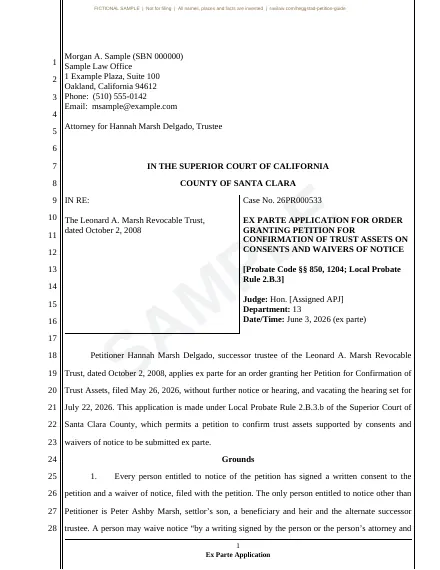
| San Diego | Ex parte drops are for routine matters without specific Probate Code notice rules, and section 850 has them; an ex parte that should have been a noticed petition may be denied. (Local Rules, rule 4.7.6.) |
| Orange | Ex parte requests must be verified, state evidentiary facts on personal knowledge, and come with a self-contained proposed order and the Probate Ex Parte Coversheet (L-3033). (Local Rules, rule 601.13.) |
| Los Angeles | Ex parte applications are non-appearance matters decided on the papers; file and serve by 10:00 a.m. the court day before the requested ruling. (LASC rule 4.12.) |
| Alameda | No ex parte hearings. Notify interested persons by 10:00 a.m. the court day before filing, and tell them objections must be filed the same day as the application. (Local Rules, rules 7.110, 7.115.) |
| Contra Costa | Applications must be verified, state evidentiary facts, and include a separate order complete in itself. (Local Rules, rule 7.104.) |
| Sacramento | File by 8:30 a.m. and notify opponents by 10:00 a.m. the court day before; show irreparable harm or another statutory basis. (Local Rules, rule 4.20.) |
| Riverside | In our experience, the court will not hear a section 850 petition sooner than 30 days after it is filed, even with every waiver on file. Make the argument anyway, and keep the fallback date. |
County local rules (chapter 14) has the ex parte rules for every county that has them.
Contents of the application
- Every consent and waiver, signed and filed, and a statement that no one has requested special notice (Prob. Code, § 17204).
- Evidence of the urgency on personal knowledge: the purchase agreement, the title company’s requirement, the lender’s deadline, the notice of trustee’s sale. A listing agent or escrow officer is often the right declarant.
- A declaration of notice of the ex parte application itself, in the form the county requires.
- A self-contained proposed order, and any county coversheet or checklist.
Probate notes, supplements and the hearing
For an uncontested petition, the probate notes posted before the hearing usually identify anything the court still needs. This chapter covers the notes, supplements, appearances and objections.
Probate notes and supplements
Most courts post an examiner’s notes or a tentative ruling before the hearing, listing anything missing. Cure the items with a verified supplement before the county’s cutoff, and many courts will approve the matter without an appearance. Miss the cutoff and the usual result is a continuance.
| County | Notes and cutoffs |
|---|---|
| Los Angeles | Probate Notes post on the court’s website; clear the “Matters To Clear” by filing supplements by the third court day before the hearing, or expect a continuance, an off-calendar order or a denial without prejudice. (LASC rule 4.4.) |
| San Francisco | File supplements at least seven court days before and deliver courtesy copies to the examiner at least five court days before. (Local Rules, rule 14.7.B.2.) |
| San Diego | Cure examiner notes with timely supplements on pleading paper or form PR-177; file later documents at least four court days before the hearing. (Local Rules, rules 4.6.1, 4.3.3.) |
| Sacramento | Notes post online 10 to 12 calendar days before the hearing; clear them with a verified Response to Calendar Notes at least five court days before. (Local Rules, rules 4.01(B), 4.02(A).) |
| Contra Costa | Tentative rulings generally post at least seven court days before; responses are due by close of business two court days before. (Local Rules, rule 7.55.) |
| Riverside | Examiners review about 10 days out and finalize notes three court days before; cure with verified supplements before then. (Local Rules, rule 7106.) |
Appearances
Many courts excuse appearances on matters the notes recommend for approval, but an objection made at a hearing you skipped usually produces a continuance. Remote appearance rules vary: Alameda requires a filed notice of remote appearance (form RA-010) for probate hearings (Super. Ct. Alameda County, Local Rules, rule 1.90(b)(2)), while San Francisco allows remote appearance at non-evidentiary probate hearings without one (rule 14.1.C). Check the county’s local rules before the hearing.
Objections
An objection turns the petition into a contested proceeding. Issues of fact are tried under the rules for civil actions, and civil discovery is available. (Prob. Code, § 1000, subd. (a).) If the opposing party took or kept property in bad faith, section 859 relief may be in play, and the notice must describe it (Prob. Code, § 851, subd. (c)(2); see item 4 of DE-115). Build the record as if the matter might be contested; it usually is not, but the examiner reads it the same way.
Gov. Code, § 27361.6; Rev. & Tax. Code, §§ 480, 480.3
After the order
Recording the order, the assessor’s filings, and presenting the order to title companies and financial institutions.
Recording the order
Get a certified copy.
Order it from the clerk once the order is entered. A clerk-certified court order is recordable without an acknowledgment.
Add a recording cover sheet.
A certified order rarely has the reserved space and title placement the first page of a recorded document needs, so a cover sheet becomes page one (Gov. Code, §§ 27361.6, 27324). Use the order’s exact title. Samples 1, 2, 4 and 5 each include one.
File the PCOR with it.
The preliminary change of ownership report is completed and signed by the transferee, here the trustee, not by counsel as agent. Without it, the recorder may charge an additional $20. (Rev. & Tax. Code, § 480.3.)
Address transfer tax and recording fees.
A Heggstad order confirms title; it is not a sale. Counties typically accept a $0 documentary transfer tax statement citing Revenue and Taxation Code section 11930 (transfers by gift or by reason of death) or section 11911 (the tax reaches realty that is sold, and nothing is sold), and practice varies; Los Angeles lists both grounds on its exemption notice, and San Francisco requires its own transfer tax affidavit. The $75 SB 2 recording fee applies unless an exemption in Government Code section 27388.1, subdivision (a)(2), fits. City transfer taxes are separate.
Proposition 19
If a child will keep the house as a principal residence, the parent-child exclusion may preserve part of the parent’s assessed value. The claim is form BOE-19-P, timely if filed within three years after the date of transfer, which for a trust at death is the date of death, or before the property is transferred to a third party, whichever is earlier. The home must become the transferee’s principal residence within one year, and the transferee must claim the homeowners’ exemption within one year. For transfers from February 16, 2025, through February 15, 2027, the exclusion is limited to the factored base year value plus $1,044,586. (Cal. Const., art. XIII A, § 2.1; Rev. & Tax. Code, § 63.2.)
Accounts
Send the institution a certified copy of the order, a certified death certificate and a certification of trust (Prob. Code, § 18100.5), to the department that processes estate transfers. An order that directs the institution to transfer (Prob. Code, § 856) leaves less to negotiate.
Checklist
After the order is signed
Checked items are saved in this browser.
Prob. Code, §§ 13100, 13151, 13200, 13650
Alternatives to a Heggstad petition
Another procedure may fit better, depending on the asset, its value and the documents. The thresholds below are the amounts published by the Judicial Council under Probate Code section 890 for deaths on or after April 1, 2025.
| Procedure | Fits when | Key limits |
|---|---|---|
| Heggstad petition Prob. Code, § 850, subd. (a)(3)(B) | A signed trust instrument describes the asset and the owner declared herself trustee, but title never moved. | Notice under sections 851 and 17203; the description and chain of title have to hold up. |
| Primary residence petition Prob. Code, §§ 13151 to 13154 | The decedent’s California primary residence passes to successors by will or intestacy, often to the trustee under a pour-over will, and no writing reaches it for Heggstad. | Primary residence only; gross value of $750,000 or less; at least 40 days after death. |
| Affidavit for personal property Prob. Code, § 13100 | Accounts and other personal property in a small estate. | California estate of $208,850 or less in gross value, excluding the property section 13050 describes; at least 40 days after death. |
| Affidavit for real property of small value Prob. Code, § 13200; form DE-305 | Low-value real property. | California real property, excluding the property section 13050 describes, of $69,625 or less in gross value as shown by an attached inventory and appraisal; no sooner than six months after death. |
| Spousal or domestic partner property petition Prob. Code, § 13650 et seq. | Property passing to a surviving spouse or registered domestic partner. | Does not reach property passing to others. |
| Probate | Everything else, including assets the trust never reached that are too large for the summary procedures. | Time and statutory fees. |
County local rules
Local probate rules that bear on a Heggstad petition, for every California county: pleading and notice, trust documents, probate notes, deadlines, orders, e-filing, ex parte, continuances and remote appearances. Choose a county, or choose a topic to compare counties.
Tool
Search the local rules
Summaries are ours; quotations are from each court’s local rules as we reviewed them in 2026. Rules change, so confirm the current version on the court’s website before you rely on one.
Frequently asked questions
What is a Heggstad petition?
A petition under Probate Code section 850, subdivision (a)(3)(B), asking the court to confirm that property still titled in a decedent’s name belongs to the trustee of the decedent’s living trust. It is named for Estate of Heggstad (1993) 16 Cal.App.4th 943, which held that a written declaration of trust by the owner of real property, naming himself trustee, is sufficient to create a trust in that property without a separate deed.
Do I need a deed if the trust lists the house?
Not to create the trust: under Heggstad, the signed declaration is enough. But after the settlor’s death, a recorder, title company or buyer will not treat the trust instrument alone as the trustee’s title, so the order is what makes the property usable. See chapter 3.
Who must receive notice of a Heggstad petition?
At least 30 days before the hearing: anyone who claims an interest in, holds title to, or has possession of the property, and anyone else whose interest would be affected, is served in the manner of a summons, and the trustees and beneficiaries receive the notice and petition by delivery under section 1215. Because title is in the decedent’s name, notice to her may instead go to her heirs and devisees and anyone named as executor in her will, so far as known, and to any guardian or conservator serving at her death, once she has been dead 40 days, if no personal representative has been appointed and her interest has not passed to anyone else. (Prob. Code, §§ 851, 17203, subd. (c).) See chapter 5.
Can the court shorten the notice period?
No. Probate Code section 851, subdivision (d), forbids it. When everyone entitled to notice has waived it in writing under section 1204, there is a good argument that the court may decide the petition early, and some counties allow it. Others, Riverside among them in our experience, will not hear a section 850 petition sooner than 30 days after it is filed. No appellate court has decided the question. See chapter 10.
Where should a Heggstad petition be filed?
In the county where the trust’s principal place of administration is, which is usually where the successor trustee lives and runs the trust. If the trust is administered outside California, the civil venue rules apply, and for real property they point to the county where the property sits. See chapter 4.
Can a general assignment or a general description support a Heggstad petition?
Yes, when extrinsic evidence such as public title records makes the description certain. Ukkestad v. RBS Asset Finance, Inc. (2015) 235 Cal.App.4th 156 directed the probate court to grant a petition for parcels the trust described only generally, and declined to follow contrary dicta in Kucker v. Kucker. Sample 2 shows the evidence.
What if the house was deeded out of the trust to refinance?
Record title in the decedent’s individual name raises a presumption, rebuttable only by clear and convincing proof, that she owned the full beneficial title (Evid. Code, § 662). Trust terms allowing title in any form (Heaps v. Heaps), a later amendment listing the property, and the lender’s escrow instructions are the usual evidence. Sample 4 shows the record.
Can a Heggstad petition be used for bank accounts?
Yes. The trust statute of frauds applies only to real property, and an order under Probate Code section 856 can direct the institution to transfer the account to the trustee. Serve the institution through its agent for service of process. See chapter 7 and chapter 8.
Can I verify the petition as the attorney?
Sometimes, but have the trustee sign. Section 1023 lets the attorney verify when the petitioner is absent from the county or otherwise unable to, unless the petitioner is a fiduciary appointed in the proceeding, and an attorney’s verification is weak evidence of facts the attorney does not know. See chapter 6.
What if an heir cannot be found?
For a trustee or beneficiary whose address is unknown, notice is given as the court requires under Code of Civil Procedure section 413.30, unless the court dispenses with it. (Prob. Code, § 1212.) An heir entitled to service in the manner of a summons needs an order under Code of Civil Procedure section 413.30 or 415.50. Document a diligent search first (Cal. Rules of Court, rule 7.52), and ask early, because publication or another step takes time. See chapter 5.
How long does a Heggstad petition take?
Hearing dates depend on the county: Los Angeles will not set one sooner than six weeks after filing, and Orange County sets them at least 40 days out. From filing to a recorded order, plan on several months, longer if notice is complicated or the probate notes lead to a continuance.
What should the proposed order include?
It should stand alone: the petitioner and the trust, the hearing, findings that notice was given and the allegations are true, and the asset described for its reader (street address, APN and full legal description for real property; institution and last four digits for an account), confirmed as a trust asset subject to any recorded encumbrance. See chapter 9.
What do I record after the order?
A clerk-certified copy of the order, under a recording cover sheet, with a PCOR signed by the trustee, in the county where the property is. See chapter 12.
Does the order trigger a property tax reassessment?
The change in ownership happened at the death, not at the order. The trustee’s change in ownership statement (BOE-502-D) is due within 150 days after the death, and if a child will keep the home as a principal residence, the Proposition 19 parent-child exclusion may preserve part of the assessed value. See chapter 12.
Are the sample petitions court-approved forms?
No. They are fictional samples prepared for the legal community. Every name, property and case number is invented, they are not legal advice, and downloading them does not create an attorney-client relationship.
Table of authorities
The authorities cited in this guide and in the samples, linked to their sources. The numbers after each entry are the chapters that cite it; S1 to S5 are the samples.
Cases
- Estate of Heggstad (1993) 16 Cal.App.4th 9431, 3, 4, 15 · S1 S2 S3 S4 S5
- Ukkestad v. RBS Asset Finance, Inc. (2015) 235 Cal.App.4th 1562, 3, 6, 15 · S2
- Heaps v. Heaps (2004) 124 Cal.App.4th 2863, 6, 15 · S4
- Carne v. Worthington (2016) 246 Cal.App.4th 5483, 6 · S4
- Estate of Powell (2000) 83 Cal.App.4th 1434S2
- Osswald v. Anderson (1996) 49 Cal.App.4th 8123
- Kucker v. Kucker (2011) 192 Cal.App.4th 902, 15 · S2
Probate Code
- § 850passim · S1 S2 S3 S4 S5
- § 851passim · S1 S2 S3 S4 S5
- § 851.17
- § 8562, 6, 7, 9, 12, 15 · S3 S4
- § 85911 · S1 S2 S3 S4
- § 8907, 13 · S3
- § 10007, 11 · S3
- § 10216
- § 10236, 15
- § 12042, 5, 10, 15 · S5
- § 12125, 15
- § 12151, 5, 15 · S1 S2 S3 S4 S5
- § 70514 · S2
- § 70524
- § 130507, 13
- § 131007, 13 · S3
- § 131517, 13
- § 1320013
- § 1365013
- § 152003 · S3
- § 152063 · S3
- § 152073 · S3
- § 16061.71, 6 · S1 S2 S3 S4 S5
- § 170024, 6 · S1 S2 S3 S4 S5
- § 170051, 4, 6 · S1 S2 S3 S4 S5
- § 172004 · S1
- § 172031, 5, 10, 13, 15 · S1 S2 S3 S4 S5
- § 1720410 · S5
- § 18100.57, 12 · S5
Code of Civil Procedure
Corporations Code
Revenue and Taxation Code
Forms
- DE-115 Notice of Hearing on Petition to Determine Claim to Property1, 2, 5, 11 · S1 S2 S3 S4
- DE-120(P) Proof of Personal Service of Notice of Hearing1, 2, 5, 8 · S1 S2 S3 S4
- DE-305 Affidavit re Real Property of Small Value13
- EFS-020 Proposed Order (Cover Sheet)2, 9 · S1 S2 S3 S4 S5
- POS-015 Notice and Acknowledgment of Receipt5
- RA-010 Notice of Remote Appearance11
- SUBP-010 Deposition Subpoena for Production of Business Records2, 7 · S3
- SUBP-025 Notice to Consumer or Employee and Objection2, 7 · S3
- PRO 010 Probate Case Cover Sheet and Certificate of Grounds for Assignment to District (Los Angeles)2, 4, 6 · S1
- L-3033 Probate Ex Parte Coversheet (Orange)10 · S5
- PB-4078 Probate Ex Parte Relief Checklist (Santa Clara)10 · S5
- PR-167 Trust Coversheet and PR-177 Response to Probate Notes (San Diego)11 · S4
- BOE-502-A Preliminary Change of Ownership Report (sample)1, 12, 15 · S1 S2 S4 S5
- BOE-502-D Change in Ownership Statement, Death of Real Property Owner (sample)1, 12, 15 · S1 S2 S4 S5
- BOE-19-P Claim for Reassessment Exclusion, Transfer Between Parent and Child (sample)12 · S4
Local rules
Statutes, rules, forms and local rules were checked in October 2026. Dollar thresholds that adjust under Probate Code section 890 are stated for deaths on or after April 1, 2025.